

To hire a hotel housekeeping supervisor, write the posting around supervisory work rather than cleaning work, and screen resumes for people who have already been accountable for other people’s results. Interview for judgment instead of technique, check references on your finalists before the offer goes out, pay inside the market range for a hotel, and put a structured first 90 days in place so the person you hire stays. Most serious candidates for this role can already clean to standard, so cleaning skill will not tell you who to hire. What decides it is supervisory judgment: whether the person can hold a team to a standard, and whether they can rebuild the room assignments when three attendants call out on a sold-out night.
Tumi Hospitality has staffed hotels and resorts since 2005. Housekeeping supervisor is one of the roles we fill. We are the largest hospitality staffing firm in Texas, and we know how tight this seat is right now. At the end of 2024, 65% of hotels surveyed reported staffing shortages, and housekeeping was the most common gap, named by 38% of them.
What does a hotel housekeeping supervisor do?
A housekeeping supervisor is accountable for other people’s rooms. That is what separates the job from the two roles closest to it. A senior room attendant is the strongest cleaner in the department and answers for their own rooms. An executive housekeeper owns the department as a whole: the budget, the labor forecast, payroll, hiring, vendor relationships, and the standard itself. The supervisor runs the shift inside that framework. This is why a great attendant does not automatically make a great supervisor. The attendant is judged on their own work, and the supervisor is judged on work other people did.
Inside a shift, the supervisor builds and rebuilds the room assignments as departures, stayovers, and early arrivals move around. They inspect finished rooms and release them for sale. When an attendant misses something, they retrain on that specific thing and then check the next few rooms to confirm the correction held. When someone calls out, they cover it by reassigning whole sections, or by working rooms personally when there is no other option. The supervisor also handles service recovery on the floor, keeps the front desk current on room status, and watches carts, linen par levels, and supplies so the shift does not stall waiting on stock.
Hiring room attendants is a different process with a different candidate pool, and we cover it on our housekeeper staffing page.
What qualities matter most in a housekeeping supervisor?
Our area managers are in the properties we staff every week, and what they see is that a new supervisor’s first real test comes early in their first month. For the first two weeks, the team is still getting to know the person and gives them room. After that, there is a week when the team starts finding out whether the standard is actually enforced when the person enforcing it is tired and short two attendants. The qualities that decide how that week goes are the ones to hire for, and you can see signs of each one while you are still reading resumes.
Start with accountability for work the candidate did not do themselves. On a resume, that looks like a number attached to other people: attendants supervised, rooms inspected per shift, an inspection score the candidate owned.
Look next for the ability to correct someone’s work without making them quit. This is the hardest part of the job, and it is the part most likely to be missing in a candidate who has only ever been excellent at cleaning. A person can clean to your standard perfectly and still be unable to tell another attendant that their work is not acceptable in a way that attendant will accept and act on.
The other quality worth testing is what a candidate does on a shift that goes badly wrong, meaning high occupancy, several call-outs, and a board that has to be rebuilt in an hour. A candidate who has worked at a property with real occupancy swings, group business, or a heavy weekend pattern has been through mornings like that. A candidate who has only run steady, low-occupancy shifts has not, and that experience is hard to give someone in their first month.
Training ability and communication decide how quickly the rest of the department starts working the new supervisor’s way. Candidates who have run onboarding on the floor already know how to break a task down for someone who has never done it, so ask how many new hires they trained. Housekeeping teams often work in more than one language, and a supervisor who can give instructions and corrections directly in the language the attendant understands avoids the errors that come from routing everything through a third person.
Inspection judgment is worth asking about directly. Some candidates inspect against a written standard, and some inspect against whatever they happen to notice that day, and you can hear which you have in how they answer a question about what they check first in a room. Chemical and safety awareness is worth asking about too. A candidate who already reads product labels and safety data sheets without being prompted is a candidate who will notice when an attendant decants a chemical into an unlabeled bottle. Comfort with the property’s systems matters as well, because room status, assignment, and inspection all run through software now. Ask which systems the candidate has used, and ask what they did on a shift when the system went down.
Certification is uncommon in this pool. The one that shows up is the American Hotel and Lodging Educational Institute’s Certified Hospitality Housekeeping Executive. Treat it as evidence that the candidate has taken the work seriously enough to study for it. It does not tell you whether they can run a shift.
Should you promote a room attendant or hire from outside?
Either path can work, and the right one depends on what your property needs most right now. The comparison comes down to five things: speed to fill, ramp time, team reaction, standard-setting, and risk.
| What you are weighing | Promoting a room attendant from your own floor | Hiring a supervisor from outside the property |
|---|---|---|
| Speed to fill | Fastest path, because the candidate is already on property, already cleared to work, and can start on the next schedule. | Slower, because you are posting the role, screening applicants, interviewing, and running background checks before anyone starts. |
| Ramp time | Fast on property knowledge, because the person already knows the rooms, the linen flow, and the team. Slow on supervisory skill, because they have never practiced it. | Fast on supervisory skill if you hired well, because the candidate has run a shift before. Slow on property knowledge, because the rooms, the systems, and the standard are all new. |
| Team reaction | Generally positive, and it shows the floor that promotion is real. The promoted attendant still has to establish authority with people who were peers the week before. | The team will test a new supervisor from outside for the first several weeks, and that supervisor has no history with them to draw on. |
| Standard-setting | The new supervisor inherits the standard the department already runs on. That is an advantage when the standard is strong. It works against you when the standard is the thing you are trying to fix. | An outside hire can bring a standard the department does not currently have, which is the main reason to choose this path. |
| Risk | A strong cleaner may turn out not to want the people side of the job, and a failed promotion can cost you a good attendant along with the supervisor. | A bad outside hire is expensive and slow to discover. In the first few months, a supervisor who is failing looks much like one who is simply still learning the property. |
Pay is where this decision most often goes wrong, and it goes wrong on the promotion side. Research comparing external hires with internal promotions found that people hired from outside are paid roughly 18% to 20% more than people promoted into the same role.

That figure is worth knowing before you promote, because it is what the outside market is paying for the seat you are about to fill internally. If you promote, move the person onto the supervisor pay scale rather than adding a small differential to their attendant rate. Give them the number before they accept, not after. A supervisor who is answering for the department’s inspection scores on something close to an attendant wage will work that out within a few months, and by then you have usually lost both the supervisor and a good attendant.
Promote from within when you have an attendant who holds the standard with nobody watching, who other attendants already go to for help, and who actually wants the responsibility. Hire from outside when the standard itself is what you are trying to change, when nobody on the floor wants the job, or when you need someone who has already run a full shift under pressure. Either way, a hire that does not hold costs far more than the difference in pay, because you pay to recruit, train, and cover the seat a second time. We work through those numbers in our article on the real cost of hotel employee turnover.
Where to find housekeeping supervisor candidates
Start with your own floor. The strongest housekeeping supervisor candidates are usually already in the building or at a sister property, and an internal posting costs nothing to run. Second, ask your current housekeeping staff for referrals. Attendants know which supervisors they have worked for and would work for again, and when an attendant refers someone, you already have a reference, because that attendant has worked under the person they are recommending.
Hospitality programs at local colleges and trade schools work slowly. A relationship with one will not fill today’s opening, but it puts you in front of people who want a supervisory track before they start looking. A hospitality staffing firm makes sense when the seat is already open and a manager or a senior attendant is covering it. A firm that places hotel housekeeping supervisors screens for this role continuously, so the search is already running when you call. General job boards come last for a supervisory seat, because they produce a large stack of applications that mostly do not fit, and sorting that stack takes time you do not have while the seat is empty.
While the search runs, the shift usually falls to a manager who is already doing another job. That works for a week or two. Past that, the manager’s own work stops getting done, and the arrangement tends to become permanent, which is why we wrote how to stop managers from covering housekeeping shifts. If you are building the whole department rather than filling one seat, our guide on how to staff a hotel covers the wider picture.
What to put in the job posting
Candidates apply to what the posting describes, so describe the supervisory work rather than the cleaning work. Put the details that end candidacies later, such as the schedule and the pay, near the top where people will read them.
- Use a title people search for. “Housekeeping Supervisor” or “Housekeeping Inspector” should be the primary title. If you post an internal title that nobody outside your property uses, candidates searching for this job will not find the posting.
- State the size of the job in numbers. Give the room count, the number of attendants the supervisor will oversee, and the shifts in play. A candidate who has run 12 attendants at a 300-room property can tell immediately whether your job is a step up, a step down, or a match.
- Say what the person is accountable for. State plainly that the supervisor inspects and releases rooms, coaches attendants, adjusts assignments, and answers for the department’s scores on their shift.
- Separate requirements from preferences. List the few things a candidate must have, then list what you would like to see. When every line reads as mandatory, good candidates who fall short on one item will not apply at all.
- Describe the schedule and the physical demands as they actually are. Early starts, weekends, holidays, the on-call expectation if there is one, and the standing, walking, and lifting the job involves. Candidates who find this out after they start are the ones most likely to quit early.
- Post the pay range and the employment status. Posting the range shortens the process, because candidates who need more than you can pay stop applying and the ones who do apply have already accepted the number. Say whether the role is full time, that it is a W-2 position, and what the benefits include.
- Say how to apply and when you will respond. Give a response window and hold to it. In a market this tight, a candidate left waiting for an answer has usually taken another job.
How to screen applicants down to a shortlist
A posting written around supervisory work still produces a stack that is mostly room attendants. Sort the stack before you book a single interview.
Read each resume for accountability rather than tenure. A resume that lists rooms cleaned per day, sections worked, and years in the department is an attendant resume, however impressive the years. What you are looking for is a line where the candidate answered for work they did not do themselves: attendants supervised, rooms inspected per shift, an inspection score they owned, new hires trained. That read usually splits the stack three ways: people who have supervised, people who were the lead or the trainer on a floor without ever carrying the title, and people who have only cleaned. Interview the first two groups. The people who led or trained without the title are where most internal promotions come from.
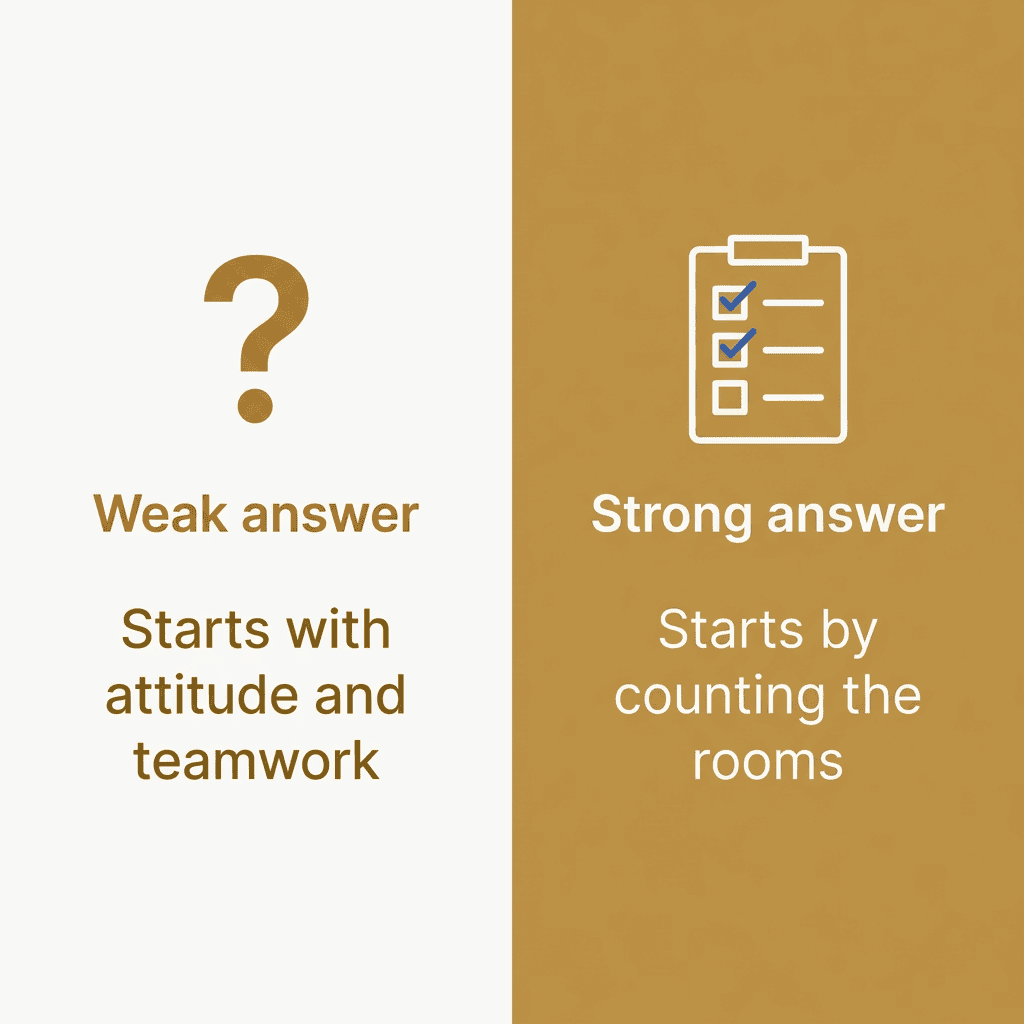
Then screen by phone before you spend an interview slot. Keep the call short and use it to settle the things that end candidacies later. Confirm the schedule as posted, including the early start and the weekends. Confirm the pay range. Describe the property honestly, including room count, attendant count, and occupancy pattern, because a candidate who has run 8 attendants at a 90-room select-service property needs to know what 300 rooms will feel like. Then ask one situational question and pay attention to where the candidate starts rather than how polished the answer is. Ask what they would do first if they walked in and two attendants had called out. A candidate who has done the job starts by counting rooms. A candidate who has not starts talking about attitude and teamwork.
References come after the interviews and before the offer, on your final one or two candidates only. A former supervisor will usually take one call about a candidate, so save it for someone you are close to hiring. Ask for the person who supervised the candidate directly rather than the HR line, which will usually confirm dates and title and nothing else. Employment dates, job titles, reason for leaving, and eligibility for rehire are all fair to confirm, and so are questions about performance, reliability, and how the candidate handled their team.
Three questions do most of the work on a reference call. Ask whether the candidate’s own attendants stayed on their shift, because a supervisor whose team stays is a supervisor who corrects people in a way they can accept. Ask who answered when a room came back wrong. And ask whether they would put this person back on a floor tomorrow. Background checks belong in the same window, after the interview and before the offer, and they are fine as long as you run the same check on every candidate for the same role.

Interview questions that separate a supervisor from a senior room attendant
Most interview questions for this role test cleaning knowledge, which every serious candidate already has. Ask about situations instead. A candidate who has handled the situation gives you specifics: the defect, the number of rooms, what they said to the attendant. A candidate who has only watched someone else handle it answers in generalities.
Start with holding a standard. Ask: “Tell me about an attendant whose rooms kept coming back short of standard. What did you do the first time, and what did you do when it happened again?” A strong answer names the specific defect rather than calling the work sloppy, describes retraining and a follow-up inspection to confirm the correction held, and escalates only after documenting the pattern.
The second question is about a morning that has already gone wrong. Ask: “You have 180 departures and three attendants call out an hour before the shift starts. Walk me through your first hour.” Listen for a candidate who counts the work first, then triages by arrival time and by rooms with accessibility or VIP requirements. A good answer reassigns whole sections rather than spreading everyone thin, and it includes telling the front desk early which rooms will be late.
For coaching, ask how the candidate would train an attendant who is fast but misses details, and how that differs from training one who is careful but slow. These are two different problems and they need two different plans, and the answer should describe checking specific rooms afterward rather than offering general encouragement.
For anyone you are considering promoting, test the move from peer to supervisor. Ask: “Tell me about a time you had to correct someone who used to be your peer, or who had been at the property longer than you.” A strong answer describes a private conversation, a clear statement of what needed to change, and a follow-up. A candidate who has never had to do this is a bigger risk on an internal promotion than on an outside hire.
One more question tests how the candidate reports bad news upward. Ask: “You finish a shift 14 rooms short of your target. What do you tell the executive housekeeper?” You want an answer that leads with the number, gives the cause without assigning blame, and says what the candidate needs the next day to keep it from happening again.
Finish the interview on the floor. Take the candidate to two or three rooms that have already been cleaned and released for sale, and ask them to walk each one and tell you what they would pass, what they would fail, and why. This is the most direct evidence of inspection judgment available to you before the person is on payroll. Listen for whether they check the same items in the same order in every room, whether they can name a defect rather than saying a room feels off, and whether they can tell the difference between a miss that sends the room back and one they would mention to the attendant while still releasing it. Do this with internal candidates too. An attendant who cleans beautifully and cannot find anything wrong in someone else’s finished room is not ready to inspect yet, and the promotion needs training behind it.
How to choose between two strong finalists
Two good finalists are rarely strong on the same things. One will answer the standard-holding questions well and turn vague when you ask about a morning with three call-outs. The other will be calm through every recovery question and will not be able to describe what they did about an attendant who kept missing the same thing.
Decide by which of those two problems your property produces more often. A property with steady occupancy and an inspection score problem needs the candidate who holds the standard, because the hard mornings are rare and the standard is the thing that is broken. A property with heavy group business, weekend swings, or chronic call-outs needs the candidate who can rebuild the board, because that is most mornings. When the two are genuinely close, hire the one whose weakness you can train. Recovery gets better with a few weeks of building the board next to someone who has done it, and with a labor forecast the supervisor can see for themselves. A candidate who is uncomfortable telling another adult their work is not acceptable rarely becomes comfortable with it, whatever support you put around them.
Some things should end a candidacy regardless of how well the rest of the interview went. A candidate who describes former attendants as lazy or sloppy and cannot name one specific defect is showing you how they will coach. A candidate who has never corrected anyone is applying for a job they have not done. A candidate who negotiates the posted schedule in the interview will not accept it in March. A candidate who fails every room on the walk without being able to say what they are measuring against is as much of a problem as one who passes a room with an obvious miss in it. And if a former supervisor will not say whether the candidate is eligible for rehire, give that more weight than a good interview.
How much does a hotel housekeeping supervisor make?
Hotels pay this role below the cross-industry figure, so start with the hotel number. In the most recent published breakout for traveler accommodation, covering May 2025, the median wage for first-line supervisors of housekeeping and janitorial workers was $21.96 per hour, with mean annual pay of $49,020. Across all industries the same occupation runs a median of $23.61 per hour. That is the number a general salary search will hand you, and it is why a hotel posting built on national averages tends to be priced wrong for the market it sits in.

Your own market moves this number more than anything else, and you can look it up instead of guessing at it. The same BLS occupational wage page that publishes the national figures also breaks this occupation out by state and metropolitan area, so read the median for your own metro and post against that.
Property type and room count matter next. A full-service property with 400 rooms is a materially bigger job than a select-service property with 90, and the range should say so. Scope matters as well, so a supervisor responsible for inspection, scheduling input, and a large team should be paid above one who runs assignments on a single shift. Classification is a separate question from the wage, because it changes what the seat costs you in total, and we cover it in W-2 versus 1099 workers in hospitality.
What you can ask candidates and what you cannot
Every question in this process asks about the work: what the candidate has done, how they did it, and whether they can perform the duties described in the posting. That is safe ground, and it is also where the useful answers are. What you cannot do is ask questions that touch protected characteristics. Under federal law, those are race, color, religion, sex (including pregnancy, sexual orientation, and transgender status), national origin, age for candidates 40 and over, disability, and genetic information. According to EEOC guidance, that information is irrelevant to whether a candidate is qualified, and asking about it can be used as evidence of intent to discriminate unless a business purpose justifies the question. Disability and medical questions are barred entirely before you make an offer.
The first 90 days
Plan the first 90 days before the supervisor starts, because structured onboarding is what keeps the hire in the seat. Employees who go through a structured onboarding program are 58% more likely to still be with the organization three years later, and a standard onboarding process is associated with 50% higher new-hire productivity.
Four things go in place before the supervisor’s first shift.
- Introduce the new supervisor to the housekeeping team yourself, and say out loud what they are responsible for. This matters most on an internal promotion, where the team knew the person as a peer the week before.
- Walk the property with them and inspect rooms side by side for the first several days. That is how the new supervisor learns your standard from you rather than guessing at it.
- Give the new supervisor the safety and chemical training the department requires, before they are responsible for anyone else’s use of it.
- Set checkpoints at 30, 60, and 90 days. Measure each one against something concrete: the inspection scores on their shift, how long the assignments take to complete, and whether their attendants are still there.

Whoever hired the supervisor should be on the floor with them every week through the first month. The first month is when the team finds out whether the standard holds, so the new supervisor should not be working through it alone.
Help filling a housekeeping supervisor seat
If the seat is open now and you would rather not run the search while covering the shift, we would be glad to talk it through with you. Tell us the property, the room count, and the shift you need covered, and we will put together a proposal for what filling it would look like. You can reach us through our contact page, by phone at (512) 722-6000, or by email at info@tumihospitality.com. There is no obligation, and if the right answer is promoting someone you already have, we will tell you that too.


