

To staff a hotel, build a roster for six departments: housekeeping and lodging operations, food and beverage, banquets and events, reception, facility maintenance, and overnight operations. Size each department to the coverage your property actually requires, which depends on your service level and your daily demand curve more than on your room count. Then hire in an order that puts supervision and support in place before you fill out the line.
At Tumi Hospitality, we have staffed all six of those departments for 20 years, at properties ranging from limited-service hotels to luxury resorts. The most common problem we see is a roster inherited from an organizational chart instead of built from coverage. When a property cuts a housekeeping supervisor, a dedicated laundry attendant, a kitchen steward, or a second person overnight, the work those positions did stays on the property. It moves to managers and to staff hired to do something else.
That displacement is expensive, and it lands on properties already under pressure. Bureau of Labor Statistics data put job openings in accommodation and food services at 776,000 in May 2026, a 5.1% openings rate, and the sector’s quits rate was 4.0% in April 2026. An AHLA survey published in March 2026 found more than half of hotel owners describing their properties as somewhat or severely understaffed, with labor costs their second-biggest concern behind the cost of goods.
This guide goes department by department: the positions each one contains, how to size it, and which roles are worth protecting when the budget tightens.
How Many Staff Does a Hotel Need?
Before you size any single department, establish how labor-intensive your property type is. Hours per occupied room, or HPOR, measures the total labor hours needed to service one occupied room across every department. It gives you a way to check a staffing plan against properties like yours.
HotelData.com’s benchmark data, covering January through September 2025, shows how sharply this scales:
| Property type | Average hours per occupied room |
|---|---|
| Extended stay | 1.30 |
| Select service | 1.44 |
| Full service | 2.57 |
| Resort | 4.48 |
A resort requires roughly three and a half times the labor hours per room that an extended-stay property does. This is why a staffing plan borrowed from another hotel rarely transfers. Extended-stay properties run lean because housekeeping is weekly rather than daily. Full-service hotels carry bell staff, room service, and a working food and beverage operation. Resorts add large footprints, recreation, and luxury brand standards.
HPOR works as a sanity check on your total plan. It will not build you a schedule. If your number lands well outside the band for your property type, go back through the department math and find out why.
Housekeeping and Lodging Operations
Housekeeping is the department where staffing gaps hit hardest and fastest, because unclean rooms cannot be sold. It is also the most frequently short-staffed department in the industry. An AHLA survey of 282 hoteliers, fielded in December 2024 and January 2025, found 65% of hotels reporting shortages, with housekeeping cited most often at 38%, ahead of front desk at 26%, culinary at 14%, and maintenance at 13%.

Positions to Staff
- Room attendants, who clean and reset guest rooms to your standards
- Housekeepers for lobbies, corridors, and public areas
- Laundry attendants handling linens, towels, and guest laundry
- Housemen, who move linen, stock carts, and handle heavy work on the floors
- Housekeeping supervisors and inspectors, who verify room quality and coordinate the team
- An executive housekeeper or director of housekeeping running the department
How to Size Housekeeping
Start from a rooms-per-attendant standard, then adjust for what your rooms actually require. Cornell’s research on housekeeping operations ties common practice to dividing guestrooms by 13 or 14 per attendant shift.
We place room attendants at every service level, and the figure moves predictably. Limited-service and economy properties, with smaller rooms and fewer amenities, support a higher count. Mid-scale and full-service properties sit close to the baseline. Boutique, luxury, and resort properties need a lower count, because the rooms are larger, the linen changes are more frequent, and the standards are more detailed.
The bigger sizing variable is your daily mix of stayovers and checkouts. A stayover refresh takes a fraction of the time a full checkout clean takes, and the gap is wide enough that two days at identical occupancy can require different staffing. A property running mostly stayovers on Tuesday and mostly checkouts on Sunday cannot use the same number on both days. We cover the cleaning-time math, and the injury exposure that comes with tight quotas, in more depth in our guide to hotel housekeeping staffing challenges.
One constraint to build into your quotas: California’s hotel housekeeping musculoskeletal injury prevention standard, operative since July 2018, requires covered employers to maintain a written prevention program with worksite evaluations and annual training. It exists because room attendant workloads and injury rates are directly connected. Quotas set faster than the work can safely be done produce injuries, absences, and turnover, which then make the staffing problem worse.
The Positions Properties Cut First
The dedicated laundry attendant. When this role goes, room attendants and housemen manage their own linen supply. That pulls them off the floor mid-shift and stops room turnover while they wait on linen. The payroll line disappears and the labor hours reappear somewhere less productive.
The housekeeping supervisor or inspector. This role is usually folded into the executive housekeeper’s duties. The problem is arithmetic, because inspection has a practical ceiling per person. Boston University’s Boston Hospitality Review documented one property that deliberately reduced its supervisors’ load from 60 rooms per day to 50 in order to protect inspection quality and free supervisors to engage with guests. It added supervisors to do it, and reported higher guest satisfaction afterward. Push a single executive housekeeper past that ceiling and inspection becomes a spot check.
Every hour your executive housekeeper spends inspecting or cleaning rooms is an hour not spent recruiting, training, or managing the largest hourly payroll in the building. If your department already struggles with turnover, cutting the supervisor tier is the change most likely to put an uninspected room in front of a guest, and uninspected rooms turn up in your quality assurance scores.
Food and Beverage
Food and beverage is the hardest department to forecast. Room occupancy is visible weeks ahead. Restaurant capture rates move with weather, local events, and who is in-house on a given night. That volatility is why weekly average scheduling fails here.
Positions to Staff
Front of house:
- Servers, hosts, and bussers
- Bartenders and baristas
- Food runners
- Breakfast attendants for morning service
Back of house:
- Line cooks and prep cooks
- Dishwashers and kitchen stewards
- A chef or kitchen manager, plus a restaurant manager for the outlet
How to Size Food and Beverage
Weekly averages will not get you there. Size by day and by shift, and build your baseline from covers instead of room count. A 200-room hotel with a 12% breakfast capture rate and a 200-room hotel with a 45% capture rate need different kitchens.
Two practical inputs. First, track your capture rate by day of week and by guest segment, because group business and transient business eat differently. Second, keep a cross-trained pool who can move between outlet service, breakfast, and banquet support, so a slow Tuesday dinner and a busy Thursday breakfast can be covered by the same people. Our guide to recruiting restaurant staff for your hotel covers how to build that pool.
The Position Properties Cut First
The kitchen steward. Stewarding generates no revenue, so it is an easy target when a labor cost percentage needs to come down. It is also the pacing mechanism for the entire operation. A restaurant cannot plate food without clean plates, and a kitchen with an unstaffed dish pit backs up within an hour of service starting.
When stewarding duties move to prep cooks or closing line cooks, kitchen output drops, ticket times stretch, and you are paying skilled culinary wages for dish work. Cooks notice. Replacing a line cook costs considerably more than funding the support role would have. Kitchen stewards are worth protecting in the budget for that reason alone.
Banquets and Events
Banquets are the one area where you get accurate numbers in advance. You have a guaranteed guest count, a set menu, and a run of show. That makes precise sizing possible, though the labor required swings hard on service style and room setup.
Positions to Staff
- Banquet servers, who execute floor service and plate timing
- Lead servers, who run a zone and direct newer staff
- Event captains, who run the shift and coordinate with the kitchen
- Setup crew, who handle tables, staging, dance floors, and breakdown
- Buffet attendants, who maintain presentation and replenishment
- Bartenders for hosted and cash bars
How to Size Banquets
Build from the floor plan. Standard banquet rounds seat eight to ten guests, so the table count gives you your service zones. Plated service needs tighter coverage than buffet, because courses have to land at the same time across the room and every plate is delivered individually. Buffet and family-style service allow more guests per server, since the work shifts to beverage service, table maintenance, and clearing.
Published server-to-guest ratios vary widely by brand standard and menu complexity, so we would not hand you a universal number. Build yours from your own event history and validate it against the last few functions of similar size and service style.
Two rules hold regardless of ratio. Size your setup crew separately from your service staff, because asking servers to strike a room after a five-hour plated dinner produces overtime and turnover, and the strike still runs late. And keep the event captain. Without one, your catering sales manager or executive chef ends up managing the floor, which means one of them is not selling next quarter’s business and the other is not running the kitchen.
Reception and Front Desk
The front desk is your first and last physical touchpoint with a guest, and the department that absorbs service recovery, yield decisions, and emergencies. J.D. Power’s 2026 North America Hotel Guest Satisfaction Index, reported by Hotel Dive, credited improvements in front desk courtesy and responsiveness to guest requests with lifting guest experience scores across every segment. Staffing this department well shows up directly in your scores.
Positions to Staff
- Front desk agents covering check-in, check-out, and guest requests
- Night auditors for overnight coverage and end-of-day accounting
- Concierge staff at full-service and luxury properties
- Bell staff, valet attendants, and guest service runners
- PBX or call center operators at larger properties
- A front office manager, plus supervisors on the busier shifts
How to Size the Front Desk
The most common front desk sizing error is staffing to average occupancy. Staff to your arrival and departure peaks instead. A property at 70% occupancy is comfortable at 11:00 AM and underwater at 3:00 PM if most of the day’s arrivals land in a two-hour window. Sixty arrivals at four minutes each is 240 minutes of continuous transaction time. One agent working that window builds a line that does not clear.
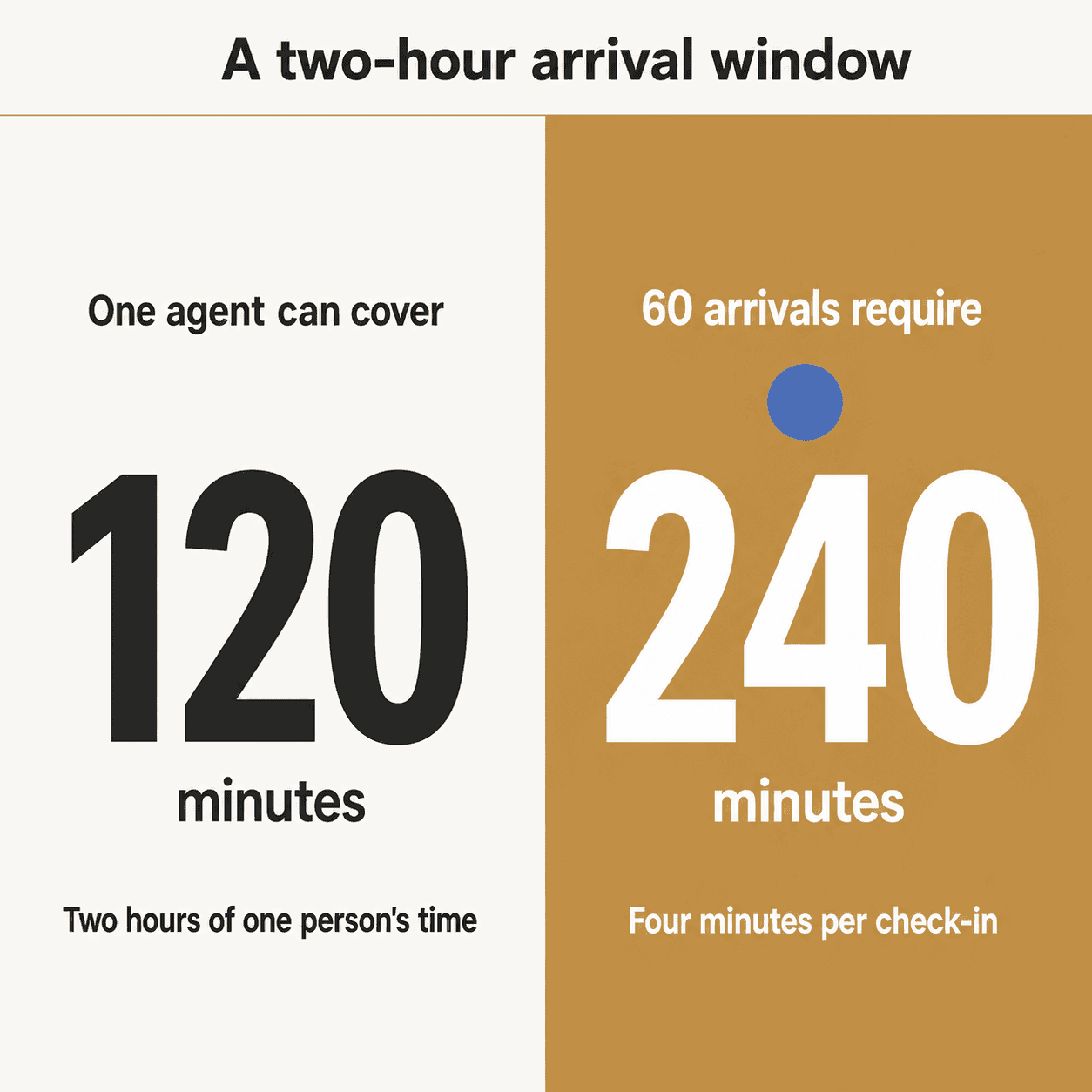
So pull your arrival and departure curves for the last several months, find your worst two-hour windows, and staff those specifically with split shifts or cross-trained support from other departments. Then size your off-peak coverage separately, and never below one agent at any hour.
Self-service tools do move the number. HotelData.com reported guest services hours per occupied room falling 13.5% to 0.39 across its sample through September 2025, which it attributed to better peak-matching and digital check-in. That is a genuine efficiency. It lowers transaction volume without flattening the peak, and someone still has to handle the guest whose mobile key fails at 3:15 PM.
Facility Maintenance and Engineering
Maintenance staffing scales with the age, footprint, and systems complexity of your building more than with its room count.
Positions to Staff
- General maintenance technicians for daily repairs and guest room issues
- Engineers managing building systems
- Licensed specialists including electricians, plumbers, and HVAC technicians
- Groundskeepers, landscapers, and painters
- Pool attendants, and golf course maintenance staff at resort properties
- A chief engineer or director of engineering
How to Size Maintenance
Index your roster to your building’s position in its renovation cycle. Maintenance and capital requirements arrive in waves rather than a straight line, and brand standards track those waves closely. As hotel asset managers told CoStar, brands generally work to a seven-year cycle for replacing soft goods and a 12 to 14 year cycle for full renovations. The years running up to each of those points are when your engineering team absorbs the most reactive work, because components are at the end of their service life and have not been replaced yet.
Practically, a hotel built in the early 2000s needs a heavier and more skilled engineering roster today than a property of identical size built last year, because preventive maintenance has given way to reactive repair.
What Happens When Engineering Is Short
Two things, and the second is worse. First, low-skill tasks like resetting door locks, plunging toilets, and delivering rollaways move to housekeepers and front desk agents, which slows the rooms division and delays the guest.
Second, preventive maintenance stops. When engineering is in permanent triage, PM cycles are the first thing abandoned, and abandoning them accelerates the physical decline of the asset. That bill arrives at refinance or sale, when deferred maintenance turns into a property improvement plan the buyer negotiates against your price. Understaffed engineering is one of the few staffing decisions that shows up on the balance sheet years later.
Overnight Operations
The overnight shift, generally 11:00 PM to 7:00 AM, is the hardest to fill and the easiest to under-plan. The night auditor role alone combines financial reconciliation, front desk coverage, and building security into one position.
Positions to Staff
- Night auditors handling reconciliation and overnight guest service
- Overnight cleaners and janitors resetting public areas for the morning
- Night kitchen stewards, including hood, oven, and cooktop deep cleaning
- Third-shift laundry attendants processing the day’s linen
- Bellmen and overnight security at larger properties
How to Size Overnight
Overnight is the one department you size as a floor. Decide what has to be true at 3:00 AM: someone reconciling the day, someone available at the desk, and the property reset before the day shift arrives. Then count how many people that takes at your size, rather than assuming one person covers all three.
Expect to pay a shift differential. Overnight roles are harder to fill because of the health effects of sustained night work, which NIOSH research links to disrupted sleep and circadian rhythms, fatigue, and higher injury risk. A premium over your daytime base rate is the cost of attracting and keeping people who will hold the shift. We wrote separately about why overnight hotel positions are so hard to fill.
The Risk of the Solo Auditor
Staffing overnight with one person on property carries risk that has little to do with labor efficiency. A single auditor facing a guest medical emergency cannot simultaneously secure the building, assist the guest, meet first responders, and cover the desk. The same is true of a burst pipe or a fire alarm at 2:00 AM, which cannot be handled without leaving the property unattended. Properties that skip overnight security or a second auditor are transferring that exposure onto one isolated employee.
What Order to Hire In
Sequence matters as much as headcount, particularly if you are opening, reopening, or rebuilding a department.
- Department leadership first. Your executive housekeeper, chief engineer, front office manager, and chef need to be in place before their teams, because they set the standards their teams will be trained to.
- Supervisors and inspectors second. Bringing on twenty room attendants with nobody to inspect their work produces twenty differently cleaned rooms.
- Core line positions third, sized to your baseline occupancy rather than your peak.
- Support roles at the same time as the line. Laundry attendants, housemen, and stewards are what let line positions stay productive. Add them last and your first weeks run inefficiently.
- Flex and buffer capacity last, once you know from operating data where your bottlenecks are.

How Much Buffer Capacity to Build In
A roster staffed to a mathematically perfect standard with no margin fails on its first bad day. With a 4.0% monthly quits rate in the sector, plus PTO, illness, and same-day call-offs, you will be short at some point. What matters is how you cover it.
Cornell researchers Tracey and Hinkin studied turnover costs across 33 US hotel properties and found that lost productivity accounted for 47.1% to 67.6% of the total cost of turnover, with total cost per departure reaching $7,612 at independent hotels and $6,957 at chain properties. Most of what turnover costs you is the productivity your remaining team and your managers lose while covering the gap and training a replacement. The job posting is a rounding error next to it.
Three ways to build the margin without carrying idle payroll:
- Cross-train an internal float pool. Staff who can move between the desk, the floors, and banquet support let you send labor at whichever bottleneck the day produces.
- Schedule against your demand curve. Staggered start times covering your arrival and departure peaks beat uniform shifts covering an average.
- Keep an external bench. A staffing partner with trained people already familiar with your property is how most hotels cover a same-day call-off without a manager taking the shift. Our article on how to stop managers from covering housekeeping shifts goes deeper on that specific failure mode.
What to Keep In-House and What to Fill Through a Staffing Partner
There is no single right split, but the reasoning is consistent. Keep in-house the positions where continuity and institutional knowledge matter most, which usually means department leadership, supervisors, and the core of your guest-facing team.
Use a staffing partner where the challenge is volume, volatility, or persistent turnover. That tends to mean housekeeping, banquets, overnight roles, and seasonal coverage. At large resort properties we typically supply around 20% of total staff, working alongside the property’s own team rather than replacing it.
What a partner should cover for you:
- W-2 employees with real benefits. Health, dental, life insurance, and paid time off attract better candidates and keep them longer than arrangements without them. We wrote about why employment structure matters in hospitality staffing.
- Property-specific training, so people arrive knowing your standards rather than general hospitality standards.
- Bench depth for call-offs, available same day or next day from an existing pool.
- On-site management. We visit every property we serve weekly, because problems caught early cost less to fix.
- The employment overhead. Payroll taxes, workers compensation, benefits administration, recruiting, and turnover replacement move off your books. Hotels working with us typically save 12% to 18% annually on hard employment costs.
Nick, a general manager at a Hyatt resort in Texas, described what the bench is worth on a bad week. Three of his people had to leave suddenly to care for family members in other countries, and as he put it, “if you didn’t have a partner like Tumi, you’re kind of screwed.” Andrew, an assistant director of rooms at an Indianapolis hotel we have worked with for eight years, framed the underlying point about housekeeping: “It’s the heart of the house, because they really are the blood pumping center of our operation. Success of all of our other departments depends on housekeeping being adequately staffed.”
If you are weighing whether you have reached that point, our list of signs your hotel needs a staffing agency is a reasonable place to start.
Frequently Asked Questions
How many housekeepers does a hotel need?
Start by dividing your occupied rooms by 13 or 14 per attendant shift, then adjust for your service level and your daily mix of stayovers and checkouts. Limited-service properties support a higher count per attendant. Luxury and resort properties need a lower one.
How many front desk agents does a hotel need?
There is no defensible flat ratio, because the number depends on when your guests arrive rather than how many rooms you sell. Size your coverage to your busiest two-hour arrival window. Sixty arrivals at four minutes each requires 240 minutes of transaction time, which one agent cannot absorb without creating a line.
Which hotel departments are hardest to staff?
Housekeeping, by a wide margin. In AHLA’s survey of 282 hoteliers, 38% named housekeeping as a shortage area, followed by front desk at 26%, culinary at 14%, and maintenance at 13%. Overnight positions across all departments are also persistently difficult to fill.
What positions should a hotel never cut?
The support and supervision roles that keep line positions productive: housekeeping inspectors, dedicated laundry attendants, kitchen stewards, banquet captains, and adequate overnight coverage. Cutting them moves the work to managers and to staff hired for other jobs, which usually costs more than the position saved.
Building Your Hotel’s Staffing Plan
Work through your departments one at a time. Establish your labor intensity, size each department to your demand curve, protect the support and supervision roles, and decide deliberately how much buffer you are carrying and where it comes from. A roster built that way holds up on a Friday with two call-offs and a full arrival window.
If you would like to talk through your property’s specific staffing needs, request staff online or call us at (512) 722-6000. We have been doing this for hotels since 2005, and we are glad to walk through the numbers with you.


