
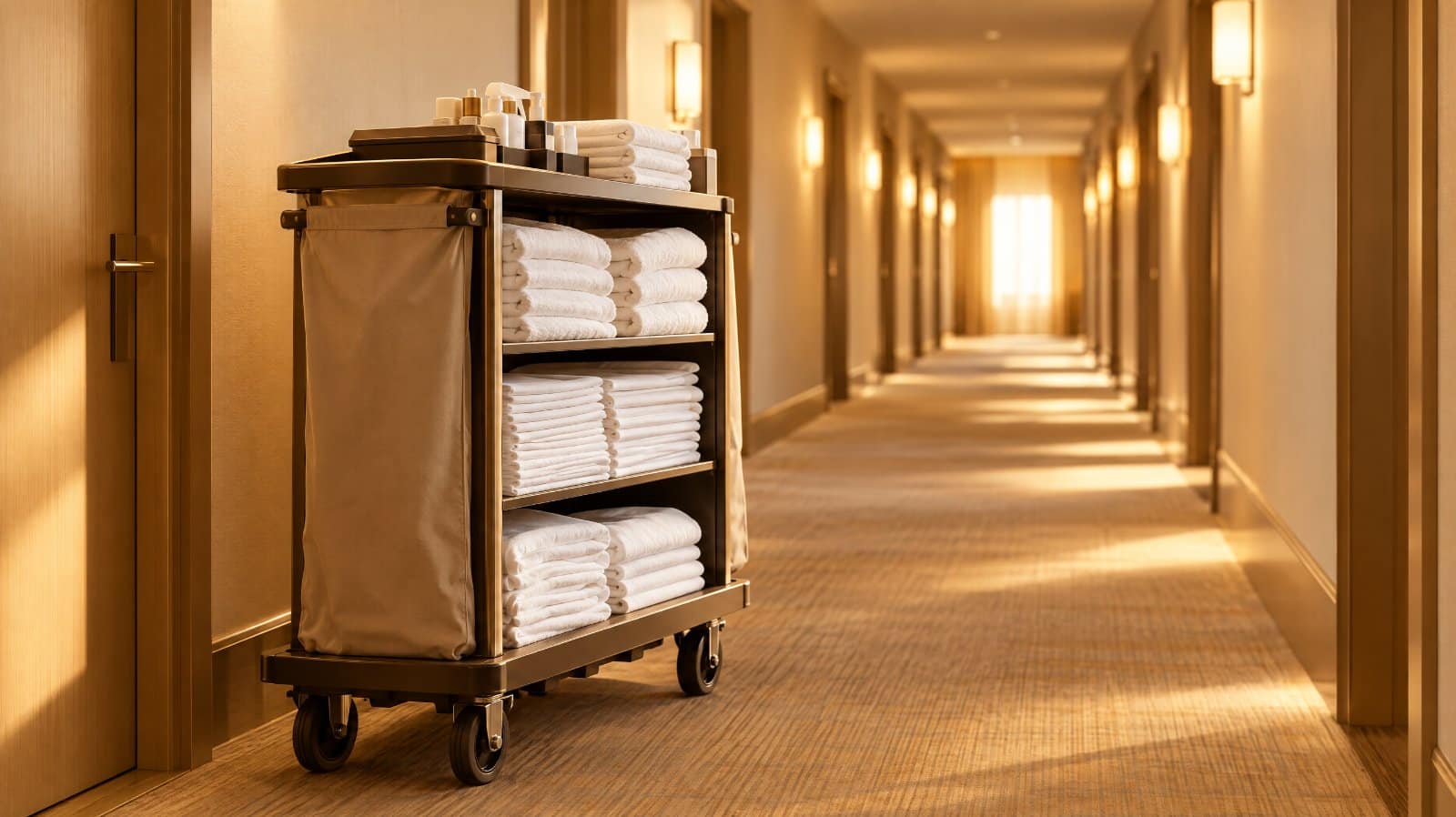
Outsourcing hotel staffing means an outside company employs some of the people who work in your hotel, usually in housekeeping, kitchen support or banquets. Your managers still set the standards for that work.
Outsourcing can lower your labor costs. Each employee costs you more than their wage once you add payroll taxes, workers’ compensation, insurance, benefits, recruiting and the cost of replacing people who leave. When a staffing partner employs the workers, those costs become the partner’s. You pay the partner one hourly bill rate that includes them. Hotels that partner with Tumi Hospitality typically save 12-18% a year on those hard employment costs.
Guest service depends on both the partner and your managers. The partner needs to keep the same trained workers at your property. Your managers need to hold those workers to the same standards as your own team.
Before you sign, confirm that the partner employs its workers as W-2 employees with benefits. Also check how it covers call-offs and what its agreement says about billing and replacements.
Tumi has been a hotel staffing partner since 2005.
What does outsourcing hotel staffing mean?
Hotels outsource staffing in one of two ways: they bring in a staffing partner’s workers to join their own departments, or they hand a whole department to a vendor that runs it with its own managers.
| Staffing partner | Managed department | |
|---|---|---|
| Who employs the workers | The staffing partner | The vendor |
| Who directs the daily work | Your department managers, with support from the partner’s supervisors | The vendor’s managers, working to standards set in the contract |
| How it’s billed | An hourly bill rate for each hour worked | A contract price for the department’s work, such as a monthly fee or a rate per room |
| Typical departments | Housekeeping, laundry, kitchen support, banquets and front desk, including overnight shifts | Housekeeping, laundry and stewarding |
| Suits a hotel that | Wants to keep running its own departments and needs more people, or more flexibility, in them | Wants to hand off an entire department, including its management |
Tumi Hospitality works as a staffing partner. If you’re weighing a managed-department vendor instead, you’ll still need to compare costs, protect guest service, understand your legal responsibilities and review the contract. The difference is the price you compare. With a staffing partner, you compare its hourly bill rate with your own cost per hour. With a vendor, you compare its contract price with what the whole department costs you now. Our complete guide to hotel staffing solutions compares both models with hiring everyone in-house.
Some hotels also outsource back-office work such as reservations and accounting to off-site providers, which is a different arrangement from staffing the property.
Which hotel jobs should you outsource, and which should you keep in-house?
The hotel jobs that make the most sense to outsource are the ones that are hard to fill, turn over often, or change with occupancy and the event calendar. Housekeeping is the department hotels most often report as short-staffed. In a 2025 survey by the American Hotel & Lodging Association (AHLA), 38% of hotels named it as a staffing shortage, ahead of the front desk at 26%.
Roles that commonly suit a staffing partner include:
- Housekeeping and laundry roles rise and fall with occupancy, so they suit a partner who can add or reduce room attendants, public area cleaners and laundry attendants as your bookings change. Our housekeeping staffing page describes these roles in more detail.
- Kitchen support roles in your hotel’s restaurants and banquet kitchens, such as dishwashers, stewards and prep cooks, are often needed on early and late shifts that are hard to cover with your own team alone.
- Banquet and event roles for your hotel’s own events, such as banquet servers and setup crews, depend on the event calendar.
- Overnight shifts, such as night cleaning, third-shift laundry and overnight kitchen cleaning, are among the hardest shifts to fill.
- Peak-season coverage at resorts and during citywide events lets you add people for your busiest weeks without hiring for the whole year.
Keep the people who set your standards on your own payroll, such as your executive housekeeper and other department leaders. Also keep one person on your own staff who is responsible for the relationship with the partner. Hospitality consultant Dina Angelucci calls this person a gatekeeper. Your gatekeeper knows your standards, checks the work against them and is the partner’s first contact when something needs attention.
You don’t have to outsource a whole department, and many hotels outsource only part of one. Angelucci recommends outsourcing only part of a department while the hotel keeps a gatekeeper on its own staff: “Hotel must retain a gatekeeper and my preferred option is the partial outsource model” (Hospitality Net). Lisa Drake, VP of development and owner relations at GF Hotels & Resorts, described a similar approach to the trade publication Hotel Management in 2022: “our goal is to continue to hire our own associates while outsourcing where and when the need exists.” At the large resorts we work with, our team typically makes up about 20% of total staff, working alongside the hotel’s own employees. For a way to work out staffing levels for each department, see our guide on how to staff a hotel.
Does outsourcing hotel staffing save money?
Outsourcing hotel staffing can save money because the staffing partner takes over the costs of being the employer. Once we employ the workers, a hotel no longer pays their payroll taxes, workers’ compensation, insurance, paid time off, recruiting, training or turnover costs, or the HR staff time spent on them. The 12-18% our hotel clients typically save each year on hard employment costs comes from no longer paying those costs. Our invoice is the full cost, with no payroll taxes, insurance premiums or benefit costs billed on top.
| Cost | When you employ the worker | When a staffing partner employs the worker |
|---|---|---|
| Wages | You pay them. In accommodation and food services, wages averaged $16.18 an hour in June 2026 (BLS). | Included in the partner’s bill rate |
| Employer payroll taxes | You pay 7.65% of wages for Social Security and Medicare (IRS). Most employers also pay federal and state unemployment taxes (IRS). | The partner pays them |
| Workers’ compensation | Your policy and your claims | The partner’s policy |
| Benefits | You pay for the benefits you offer. In accommodation and food services, insurance averaged $0.86 and paid leave $0.63 for every hour worked in June 2026 (BLS). | The partner’s cost, if it offers benefits |
| Recruiting and hiring | Your job ads, interviews and background checks. Across industries, a non-executive hire cost an average of $5,475 in 2025 (SHRM). | The partner’s cost |
| Replacing people who leave | You pay the hiring cost again each time someone leaves. In accommodation and food services, 5.5% of workers left or lost their jobs in an average month of 2025 (BLS). | The partner’s cost |
| Training on your standards | Your supervisors’ time | The partner’s cost. If your supervisors help train new workers at your property, that time is still yours. |
| Payroll, HR and timekeeping | Your staff’s time | The partner’s staff |
| Supervising the work | Your managers | Still your managers, with support from the partner |
Our article on the real cost of hotel employee turnover breaks down what each departure costs a hotel.
To compare a partner’s bill rate with what you pay now, work through one department at a time:
- Add up a year of that department’s costs: wages, overtime, payroll taxes, workers’ compensation, benefits, recruiting, training and the staff time spent on payroll and HR.
- Divide the total by the hours the department worked that year. The result is your full cost per hour.
- Compare that number with the partner’s bill rate, and confirm the bill rate covers the same costs.

Our comparison of direct hire and staffing agencies covers the differences beyond cost.
A low bill rate can cost you more if it comes from a partner that pays its workers no benefits. Those workers have less reason to stay, so the people the partner sends to your property change more often. Your supervisors then spend time training each new person on your standards and checking their work more closely until it’s right. That supervisor time is a cost the bill rate doesn’t show.
Will outsourced staff hurt guest service?
Outsourced staff can give your guests the same service as your own employees. Liz Smith-Mills, a hotel consultant and member of the UK Housekeepers Association, told the UK trade publication The Caterer there are “many success stories where agency housekeepers are fully integrated into the team.” She also warned that “if outsourcing is not managed properly, it can be a disaster.”
On the partner’s side, good service depends on keeping the same trained people at your property. At Tumi, everyone we place is a W-2 employee. Our full-time team members receive health, dental and life insurance and paid time off, with a first raise once they pass a 90-day probation and another at one year. New team members spend a week training at your property alongside either a Tumi supervisor or one of your supervisors. Your area manager visits your property every week to check on the work and meet with your managers.
A partner also has to cover shifts when one of its workers calls off. We keep backup staff available for unexpected call-offs, so your managers don’t have to work those shifts themselves. For urgent issues, our on-call customer service line is available around the clock.
On your side, hold outsourced team members to the same standards, inspections and quality scores as your own employees.
Who is the employer when you outsource hotel staff?
The staffing partner is the employer of the workers it places at your hotel. That means the partner completes each worker’s Form I-9, and your hotel does not (USCIS).
OSHA says the staffing agency and the host employer, which is your hotel, are both “responsible for providing and maintaining a safe work environment for those workers.” OSHA also expects the host employer to give these workers the same safety protections it gives its own employees (OSHA).
What happens to your current employees?
A staffing partner’s workers join your team alongside your current employees, so using one doesn’t have to change your employees’ jobs. Hotels use a staffing partner to fill positions that have stayed open and to add coverage for busy periods and call-offs. If a vendor would take over a whole department instead, ask early what would happen to the employees already in it.
If any of your employees are covered by a union contract, read it before you decide anything, because collective bargaining agreements can limit when a hotel may subcontract work its union members do. It also helps to tell your own team what the partner’s people will be doing before the first of them arrives.
How do you choose a hotel outsourcing partner?
Choose a partner by looking at how it employs its people and how it supports the hotels it already works with. Jason Reader, SVP of operations at Remington Hotels, gave this advice to Hotel Management in 2022: “Check references, and ideally the company should be handling other hotels in the market.” Before you ask for a proposal, send each partner you’re considering these questions:
- Are your workers W-2 employees with benefits?
- Will you send us certificates of insurance, including workers’ compensation, before anyone starts at our property?
- How much of your business is hotels and resorts, and which hotels in our market can we contact for a reference?
- How do you screen candidates before sending them to our property?
- How will new workers learn our property’s standards, and does that training take place at our property?
- How often will someone from your company visit our property, and who will our regular contact be?
- How do we reach you about an urgent issue at night or on a weekend?
- How do you cover a shift when one of your workers calls off?
- How long do your workers typically stay at one property?
Our guide to W-2 and 1099 workers in hospitality explains why it matters to your hotel whether a partner employs its workers as W-2 employees.
What should an outsourcing agreement include?
A good outsourcing agreement spells out what the partner will provide and how both of you will know it’s working. Check that yours covers these points:
- Roles, headcount and shifts: The agreement should name the positions the partner will fill, how many people it will provide and which days and shifts they’ll work.
- Quality standards: It should set the inspection standards and quality scores the work will be measured against, and how often you’ll review the results together.
- Replacements: It should say how you ask for a replacement when a worker isn’t the right fit for your property, and how quickly the partner will provide one.
- Billing: It should state what the bill rate includes, such as wages, payroll taxes, workers’ compensation and benefits, and how overtime and holidays are billed.
- Staffing changes: It should say how much notice you need to give to add or reduce staff as occupancy changes.
- Term and exit: It should set how long the agreement runs and how either side can end it.

How fast can an outsourcing partner start?
At Tumi, filling an ongoing staffing need typically takes 2-3 weeks, including screening and training. Same-day or next-day coverage is possible only from staff we already employ and have available, so it works best for emergency hotel staffing and short gaps. For ongoing needs, it helps to start the conversation a few weeks before you need people in place.
If you’re thinking about outsourcing part of your hotel’s staffing, we’d be glad to learn about your property and put together a proposal, with no obligation. You can reach us through our contact page, by phone at (512) 722-6000 or by email at info@tumihospitality.com.


