

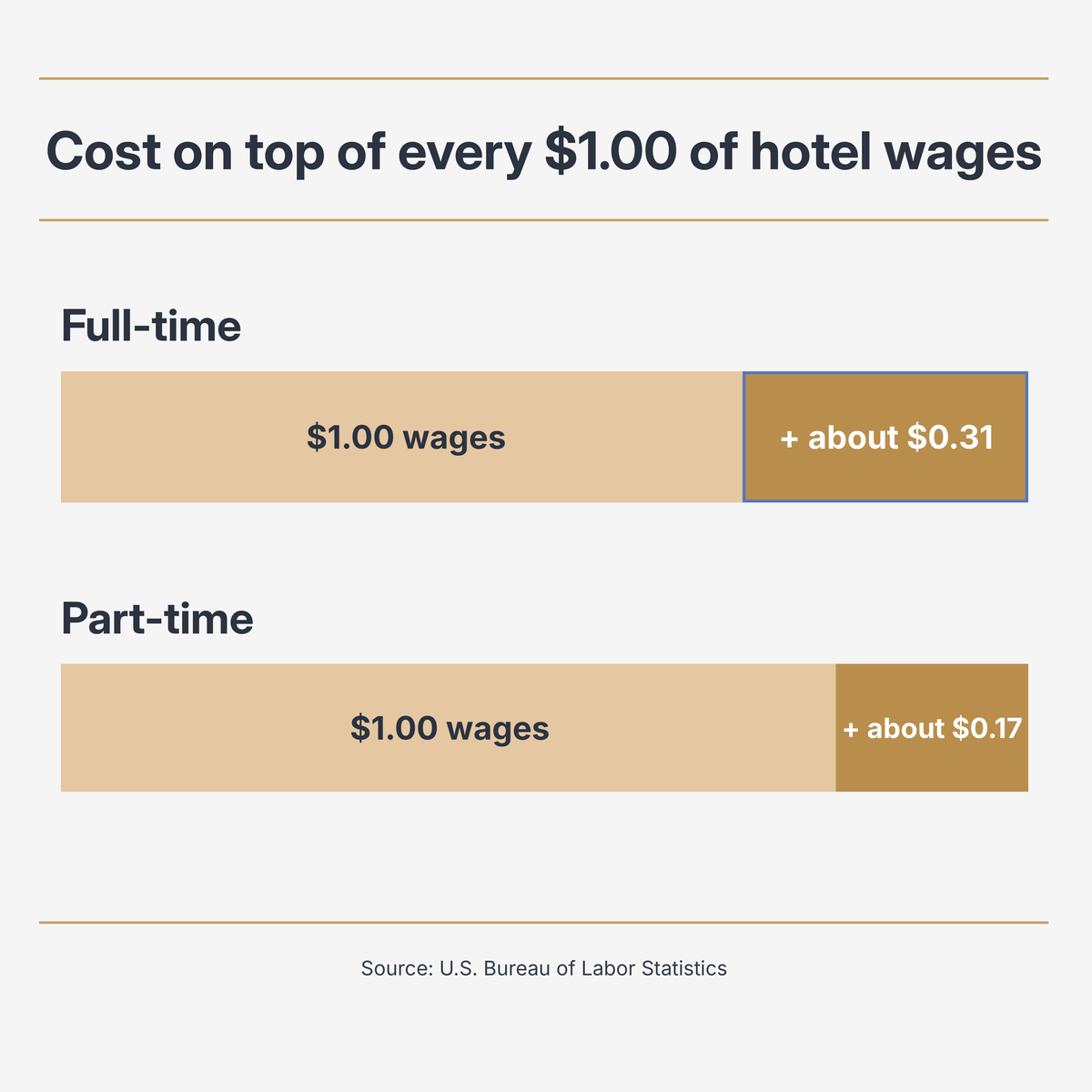
An hourly hotel employee costs noticeably more than the wage on their paycheck. For a full-time hospitality employee, benefits and employer payroll costs add about 31 cents to every dollar of wages, and for a part-time employee about 17 cents, according to national Bureau of Labor Statistics data for private-industry leisure and hospitality employers. Those costs include payroll taxes, unemployment insurance, workers’ compensation, health coverage, paid time off, retirement contributions and extra pay such as bonuses and shift premiums. Turnover and busy-week overtime come on top of that. That full cost per position is the number to put in a 2027 labor budget.
Tumi Hospitality has employed hotel staff since 2005, so we carry these same costs ourselves.
What do hotel workers make in Atlanta?
Most frontline hotel roles in metro Atlanta pay between about $13.50 and $18.50 an hour, while maintenance workers and housekeeping supervisors earn considerably more. The table shows the middle of the market for each role from the U.S. Bureau of Labor Statistics wage survey for the Atlanta-Sandy Springs-Roswell metro area, dated May 2025, the most recent data available. A quarter of workers earn less than the low figure, and a quarter earn more than the high one. For hotel restaurants and kitchens, the restaurant cook and dishwasher rows are the closest match.
| Role | Atlanta metro hourly range (25th to 75th percentile) |
|---|---|
| Housekeepers (maids and housekeeping cleaners) | About $13.91 to $17.93 |
| Hotel desk clerks | About $13.55 to $17.30 |
| Restaurant cooks | About $14.75 to $18.47 |
| Dishwashers | About $13.63 to $17.37 |
| Maintenance and repair workers | About $21.00 to $29.72 |
| Housekeeping supervisors | About $18.61 to $28.87 |
These ranges cover every employer in the metro area that hires for each job, not hotels alone. They are also more than a year old by the time a 2027 budget takes effect. Use them as a check rather than a starting point: start from what you pay each position today, then see where your rates sit against the market. A position paid near the low end of its range may need room in the budget for a higher starting rate if you expect to hire for it next year.
Servers and bartenders in hotel restaurants and at hotel banquets and events are left out of the table. Much of their income comes from tips, so a wage survey does not show what the hotel actually pays them. Use your own payroll records for those positions.
Does Georgia’s minimum wage affect hotel labor costs?
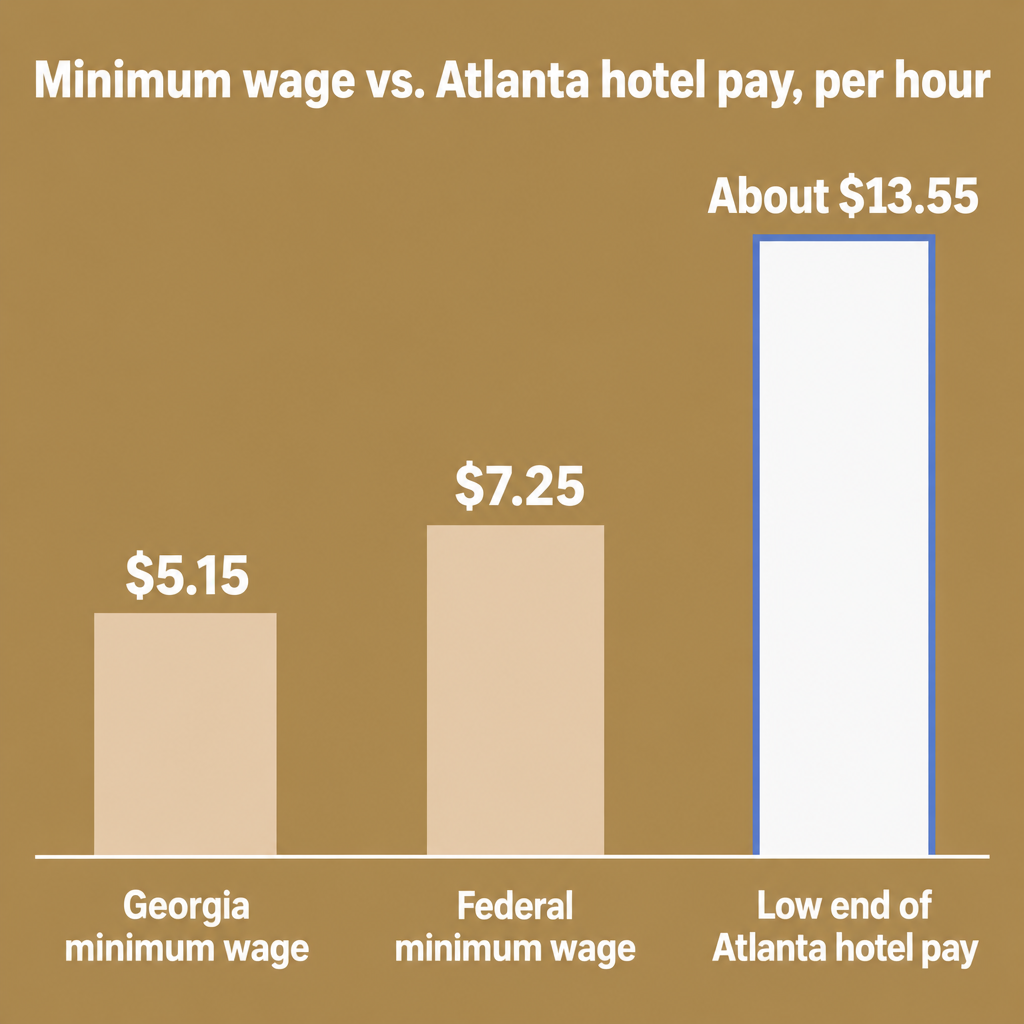
Georgia’s minimum wage has almost no effect on an Atlanta hotel’s labor budget, because market pay sits far above it. The state minimum is $5.15 an hour, but the federal minimum of $7.25 applies to most employers, according to the U.S. Department of Labor. Georgia law also bars Atlanta from setting a higher minimum of its own. Georgia has no state law requiring private employers to provide paid sick leave, so any paid time off in your budget comes from your own policy.
What does a hotel employee cost beyond wages?
On top of wages, the law requires a hotel to pay payroll taxes, unemployment insurance and, above a small size, workers’ compensation. Paid time off and the health plan you offer are set by your own policies. Those choices, along with your mix of full-time and part-time staff, decide how much these costs add for your hotel.
| Cost item | What it adds | Georgia note |
|---|---|---|
| Social Security and Medicare | 7.65% of wages: 6.2% for Social Security and 1.45% for Medicare (IRS) | The rate applies to every dollar of hourly pay, overtime included. |
| Federal unemployment tax | 6.0% on the first $7,000 of each employee’s pay, cut to 0.6% when you pay Georgia’s unemployment tax in full and on time (IRS) | Georgia employers who paid on time kept the 0.6% rate for 2025. Budget 0.6% for 2027 unless the U.S. Department of Labor reduces Georgia’s credit in its November announcement. |
| Georgia unemployment insurance | 2.70% for a new employer on the first $9,500 of each employee’s pay (Georgia Department of Labor) | Established employers receive their own assigned rate. |
| Workers’ compensation | Insurance priced per $100 of payroll; your insurance carrier sets the rate for each job class | Required for any Georgia business that regularly employs three or more people, counting regular part-time staff. |
| Health and other benefits | Whatever your plans cost per enrolled employee | The plan you offer sets the cost. |
| Paid time off | The hours you pay for vacation, holidays and sick days | Set by your own policy. |
In our experience, employer-paid health insurance runs from $500 to more than $800 per enrolled employee per month. Budget it from your plan’s actual premium and the share of each position that enrolls, rather than assuming every employee takes coverage.
What do turnover and hiring add to the cost?
Replacing a hotel employee can cost up to 30% of that person’s annual compensation, according to the American Hotel and Lodging Association. When someone leaves, the hotel pays again to advertise, interview and screen, and a supervisor or coworker spends paid hours training the new hire. The hotel also pays the unemployment taxes again on the new hire’s pay, up to the $7,000 federal cap and the $9,500 Georgia cap.
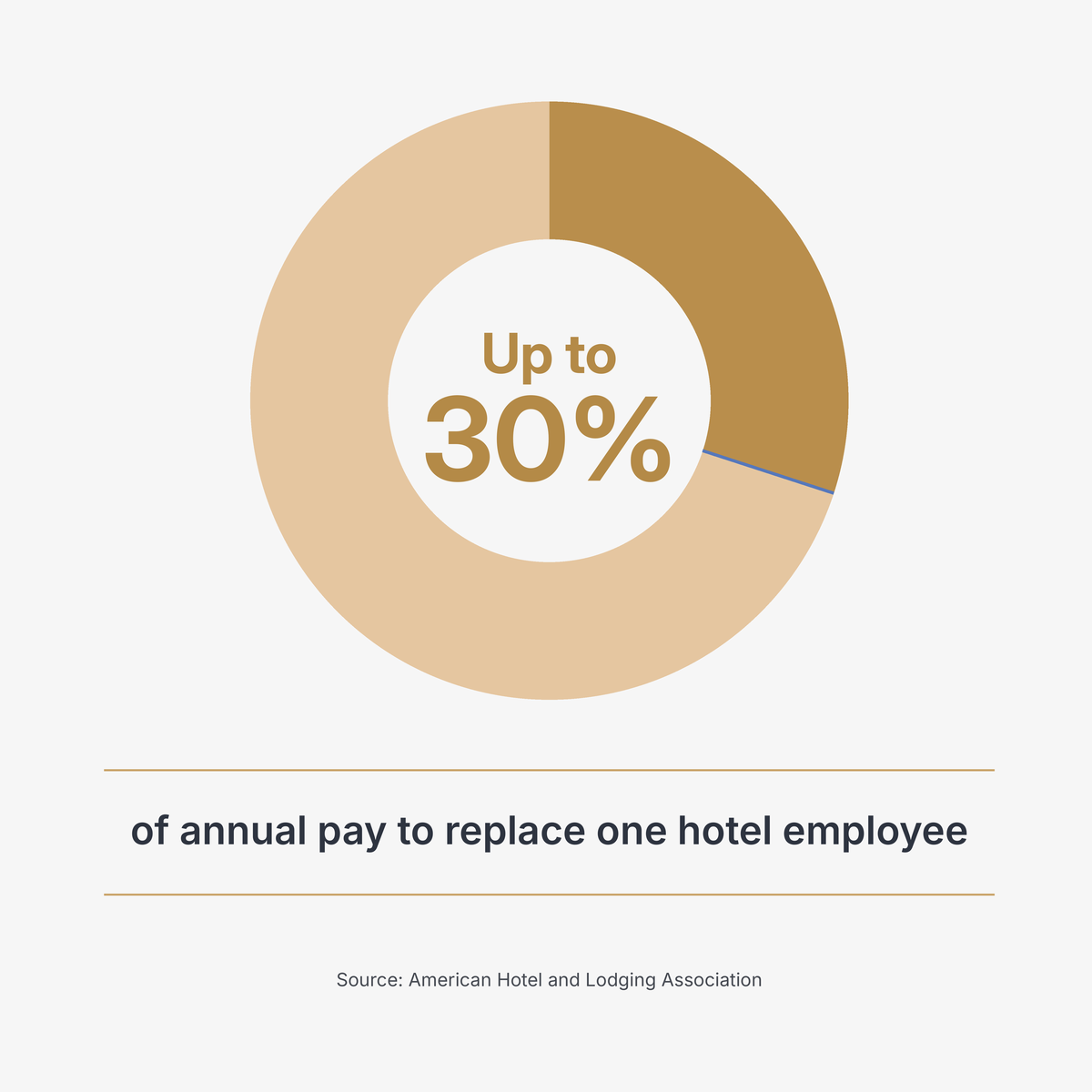
Turnover is high across the hospitality industry. In accommodation and food services, about 5.5% of the workforce left or lost their jobs in an average month of 2025, according to the Bureau of Labor Statistics. To budget for it, use your own history to estimate how many people in each position you expect to replace next year. Then multiply that number by your own cost to recruit and train one hire for the position. If you don’t track that cost, treat AHLA’s 30% of annual pay as an upper estimate. Our article on the real cost of hotel employee turnover breaks that replacement cost down in more detail.
How to budget for convention and event weeks in Atlanta
Convention weeks are among Atlanta’s busiest, so a 2027 labor budget should plan for overtime and extra staff in those weeks rather than spreading hours evenly across the year. The downtown convention campus sits within walking distance of more than 13,000 hotel rooms, and a large show can fill many of them in the same week. Any hours an hourly employee works past 40 in a week cost time and a half under federal overtime rules.
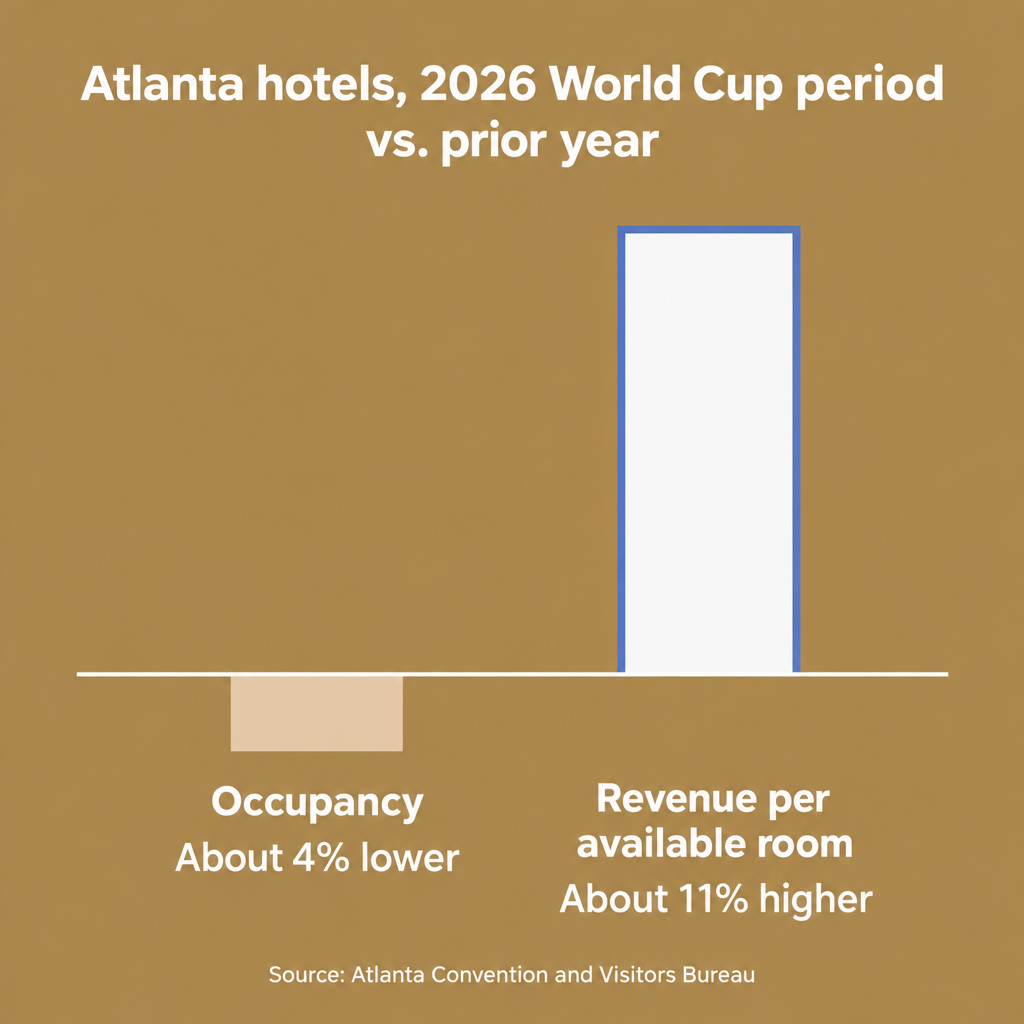
Base 2027 staffing hours on the convention calendar rather than on one large event. During the 2026 World Cup period, Atlanta hotel occupancy ran about 4% below the year before while revenue per available room rose about 11%, according to Atlanta Convention and Visitors Bureau data reported by the Atlanta Journal-Constitution. As William Pate, president and CEO of the Atlanta Convention and Visitors Bureau, put it: “Even though we’ve booked fewer rooms (than) in a typical summer, the revenue has been much higher.”
Staffing hours follow occupied rooms more closely than room rates, so higher event revenue does not necessarily mean more housekeeping hours.
How to build the labor cost for each position
You can build the yearly cost of one full-time employee in each hourly position in seven steps.
- Start with yearly wages. Multiply what you pay the position today by 2,080 paid hours (52 weeks of 40 hours). Paid time off is paid inside those hours, so it needs no separate line. Check the rate against the Atlanta range in the wage table to decide whether it needs to rise for 2027.
- Add payroll taxes. Add 7.65% of all wages. Then add 0.6% federal unemployment tax on the first $7,000 of the employee’s pay and your Georgia unemployment rate (2.70% for a new employer) on the first $9,500. Both caps apply to each employee separately.
- Add workers’ compensation. Apply your carrier’s rate per $100 of payroll for the job class, since housekeeping, kitchen and maintenance roles are often priced differently.
- Add benefits. If the employee enrolls in health coverage, multiply your monthly premium by 12.
- Add turnover. Multiply your cost to replace one person in the position by the share of that position you expect to replace next year. If you expect to replace half the people in the role, add half the replacement cost.
- Add overtime. Estimate the hours past 40 the employee will work in busy weeks, and cost them at one and a half times the regular rate, plus payroll taxes on that pay.
- Divide by hours worked. Divide the yearly total by the hours the employee actually works: 2,080 minus their paid time off, plus any overtime hours. The result is the position’s full cost per working hour, which you can compare with a staffing partner’s hourly bill rate.
Here is how the first steps work out for a full-time housekeeper paid at the low and high ends of the Atlanta range. It is an illustration, not a quote. It assumes 2,080 paid hours a year (40 hours a week, paid time off included), a new employer’s Georgia unemployment rate, and health coverage at $500 a month in the low column and $800 in the high column.
| Cost line | Housekeeper at $13.91 an hour | Housekeeper at $17.93 an hour |
|---|---|---|
| Wages | $28,933 | $37,294 |
| Social Security and Medicare (7.65%) | $2,213 | $2,853 |
| Federal unemployment (0.6% of $7,000) | $42 | $42 |
| Georgia unemployment (2.70% of $9,500) | $257 | $257 |
| Health insurance, if enrolled | $6,000 | $9,600 or more |
| Subtotal | About $37,400 | About $50,000 or more |
Workers’ compensation, turnover and overtime come on top of the subtotal, and they depend on your carrier, your turnover history and your convention calendar. As a check, the BLS figure of about 31 cents per wage dollar puts wages plus benefits and payroll costs at roughly $38,000 to $49,000 for the same pay range, within a few percent of the subtotal.
Is a staffing agency cheaper than hiring hotel staff directly?
Per hour, a staffing agency’s bill rate is higher than the wage you would pay a direct hire. Per position, once payroll taxes, insurance, benefits and turnover are counted, the full cost of a direct hire can come out higher than a staffing partner’s bill. A wage covers only pay, while a staffing partner’s bill typically also covers the payroll taxes, insurance and benefits in the cost table and the recruiting, training and turnover costs described earlier. The fair comparison is the bill rate against the full cost per working hour from the steps above.
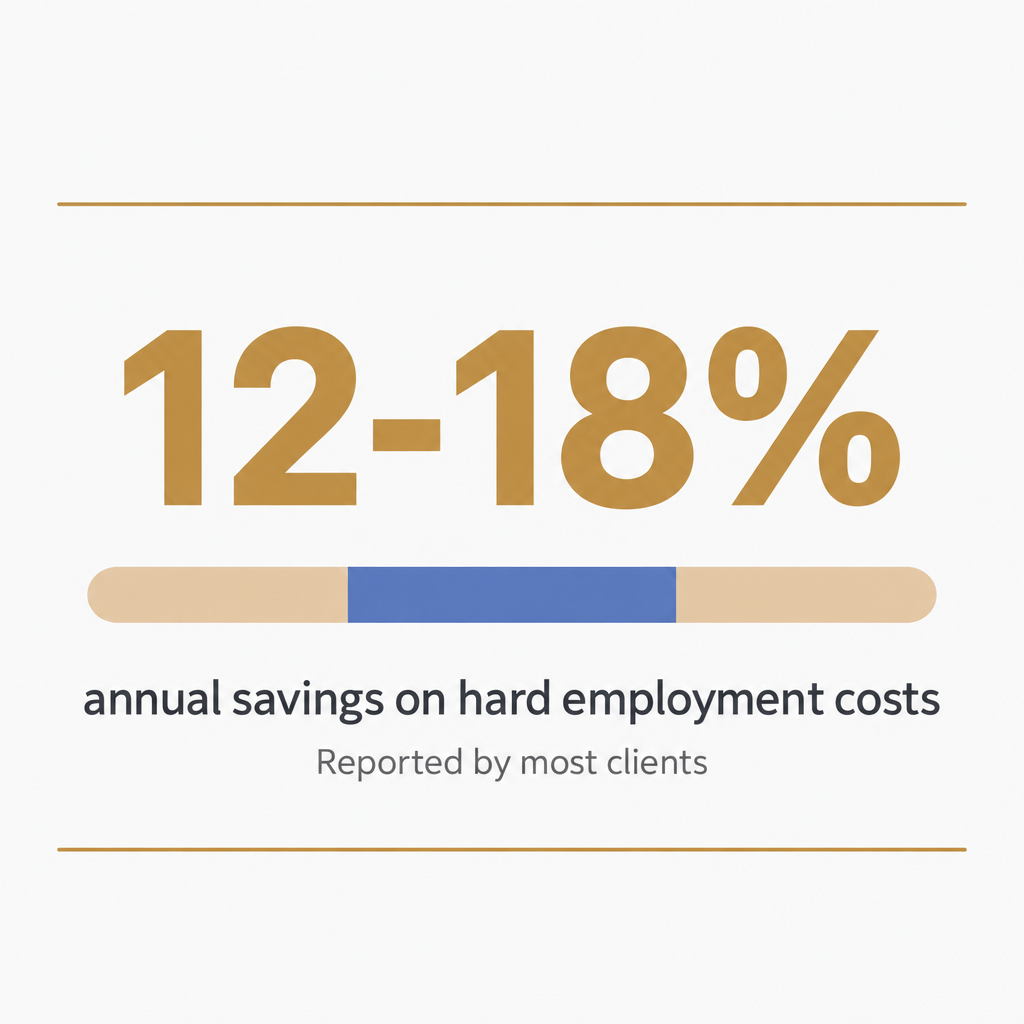
When we bill a hotel, our invoice is the whole cost, with no separate taxes, insurance, benefits or administrative charges added on. In our experience, most of our clients save 12-18% annually on hard employment costs when we compare their total cost of employing the same positions directly with our bill.
Our hotel staff are W-2 employees of Tumi. That means we pay their payroll taxes and workers’ compensation instead of your hotel. Full-time employees also receive full benefits from us, including health, dental, life insurance and paid time off. We have staffed hotels since 2005. An area manager visits the Atlanta-area hotels we serve every week.
If you are weighing the two approaches for your own hotel, our comparison of direct hiring and a hotel staffing agency covers the trade-offs beyond cost. You can also see the roles we fill and how we support hotels in the area on our Atlanta hospitality staffing page, from housekeepers to banquet servers for hotel banquets and events.
Frequently asked questions
What share of a hotel’s revenue goes to labor?
Nationally, salaries, wages and payroll-related costs take more than 32% of a hotel’s total revenue. Hotel labor costs rose 15.3% from 2019 to 2025, while operating revenue grew 12.8%, according to American Hotel and Lodging Association data reported by Hotel Dive. Within your own hotel, labor cost per occupied room is the easier measure to track month to month.
How far ahead should an Atlanta hotel arrange extra staff for convention weeks?
An Atlanta hotel should ask a staffing partner about a known convention week as early as it can. Two to three weeks is our lead time for ongoing needs, including screening and training. Same-day or next-day coverage is possible only from our existing staff pools, so it is not something to build a budget around. Once staff are in place, our on-call customer service handles urgent issues around the clock.
Talk with us about your Atlanta staffing budget
If you are building your 2027 labor budget and would like help working out the full cost of a position, we would be glad to talk it through. You can request a no-obligation consultation to discuss your staffing needs and receive a proposal built around your hotel. If you prefer, call us at (512) 722-6000 or email info@tumihospitality.com.