
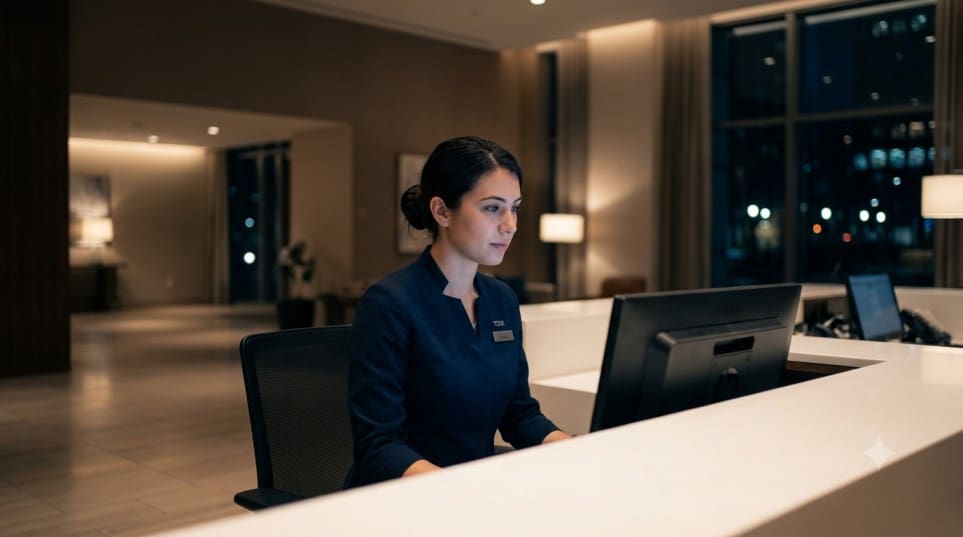
Overnight hotel roles stay open longer than almost any other position in the building, and the reason has more to do with the shift than the paycheck. Night audit usually runs solo, third-shift laundry has to keep moving while the property sleeps, and the overnight kitchen breakdown has to be finished before the morning crew clocks in. Those jobs draw from a small slice of the workforce, they wear people down faster, and they reopen the moment someone leaves.
At TUMI Hospitality, we run a dedicated overnight service built for exactly these shifts, because the same gap shows up at nearly every property we staff. As the largest hospitality staffing firm in Texas with 20 years covering hotel floors, we have learned that overnight coverage is a structural problem. The usual fixes, like more job postings, a wage bump, or splitting the schedule, rarely solve it on their own. Here is why the shift stays so hard to staff, and what actually keeps it covered.
What makes overnight hotel shifts so hard to fill
Hotel staffing has eased since its post-pandemic peak, but it has not gone away. In the American Hotel and Lodging Association’s February 2025 survey, 65% of hotels still reported a staffing shortage, with an average of six to seven open positions per property. The roles that stay open longest are the operating jobs that have to be covered around the clock: housekeeping (38%), front desk (26%), culinary (14%), and maintenance (13%).
Those same departments create the overnight exposure. When the daytime labor pool goes home, the building keeps running, and someone still has to staff the desk, reset the kitchen, and keep the laundry moving. Too often, that someone ends up being the manager. The difficulty is not abstract. It sits on the shifts almost no one wants.
The overnight shift is the least wanted work in the building
The work itself is a big part of the problem. Overnight roles tend to combine the least desirable tasks in the hotel with the least desirable hours.
A night auditor often runs the front desk alone while reconciling the day’s accounting, which means overnight front desk coverage asks one person to handle guest service and back-office work at the same time. Third-shift laundry never really stops, since the rooms turning over in the morning depend on linens processed overnight. And the overnight kitchen breakdown is physical, detailed work: the overnight dishwashers and cleaning crew have to strip down and scrub hoods, ovens, and cooktops so the property is reset before the morning team arrives.
None of these jobs are easy to sell to a candidate who has daytime options. That narrows the pool before pay even enters the conversation.
Night work takes a real toll on health
Working against the body clock is hard on people, and that is well documented. The CDC’s National Institute for Occupational Safety and Health reports that shift work disrupts sleep and circadian rhythms and is associated with higher risks of cardiovascular disease, gastrointestinal disorders, and other chronic conditions. NIOSH also notes that night and rotating shift workers report the most difficulty with sleep of any schedule.
That toll has a direct staffing consequence. The number of people who can sustain overnight work over months and years is smaller than the number who will try it, which is why night roles churn even after they are filled. A worker who takes the job in January may not last to summer, and the seat reopens.
Overnight roles are often solo, which raises the bar on who you can trust
Many overnight positions are worked alone, and that changes both who is willing to do them and who you can place unsupervised. OSHA lists working late at night, working alone or in isolated areas, and working where alcohol is served among the recognized risk factors for workplace violence. A hotel night audit shift often checks all three boxes at once.
The role is also less forgiving than it looks. The Bureau of Labor Statistics found that for hotel and resort desk clerks, 69.1% of jobs had a variable work schedule and 27.7% had no supervisor present in the immediate work area. Overnight, that usually means one person, no backup nearby, and whatever the night brings. The same logic applies to overnight maintenance coverage, where a single technician may be the only person who can respond when something breaks at 3 a.m. Hotels are right to be selective about who works those hours, and that selectivity shrinks an already small pool.
The candidate pool for night work is small to begin with
Even setting aside the difficulty and the health toll, the math works against night coverage. Most people work days, and only a small minority work nights at all. BLS schedule data show that 83.6% of wage and salary workers usually worked a regular daytime schedule, and only 3.6% usually worked a night shift. In leisure and hospitality, just 2.6% usually worked nights.
So a hotel hiring for an overnight seat is drawing from a far smaller pool than one hiring for days. Fewer people apply, and the ones who do tend to leave faster, which is why an overnight line cook or overnight cook position can feel permanently posted. It does not get filled once and stay filled. It reopens on a cycle.
That churn shows up in the national numbers. In 2025, the accommodation and food services sector ran an average quits rate of 4.2% per month, roughly double the 2.0% rate for the economy as a whole. Elevated churn across the sector hits hardest where coverage is already thinnest.
Why raising pay alone does not fix overnight coverage
The instinct is to throw money at the problem, and pay does matter. But hotels have already pulled the wage lever hard, and the shortages held. In AHLA’s June 2024 survey, 86% of hotels had raised wages in the prior six months, yet 76% still reported a staffing shortage.
Pay is also not the main reason people choose night work in the first place. BLS data on why workers pick non-daytime schedules found that only 7.2% of all non-daytime workers cited better pay as the main reason, and among night workers specifically the figure was 14.6%, below both personal preference and the nature of the job. A premium can nudge someone who already works nights. It rarely converts a daytime worker into a reliable overnight one.
Wage increases have helped, to be clear. Hotel shortages have eased since their 2023 peak, when 82% of hotels reported them. Pay helps at the margin. It just does not close the hardest coverage gaps, because the constraint on those shifts is the shift itself.
| Common fix | What it does for daytime hiring | Why it falls short overnight |
|---|---|---|
| More job postings | Widens the applicant pool for shifts people already want | The people willing to work nights are a small, fixed share of the labor market, so more postings rarely reach them |
| Higher wages | Helped hotels recover daytime staffing levels since 2023 | Pay is not the main reason people choose night work, so a premium alone rarely creates a reliable overnight hire |
| Splitting or rotating shifts | Spreads coverage and avoids burning out one person | Rotating staff through nights spreads the health toll across more of your team and tends to raise turnover, not lower it |
What actually closes the overnight staffing gap
If the constraint is the shift, the answer is access to people who already work nights and who stay long enough to be reliable. That is the bottleneck recruiting one hard seat at a time never solves. A property cannot manufacture night-shift workers with a job posting. It can partner with someone who already keeps a standing pool of them.
This is the core of how we built our overnight service. We keep night kitchen stewards, night auditors, overnight dishwashers, third-shift laundry attendants, and overnight cleaners on staff as W-2 employees with full benefits. Those are real jobs with real benefits, which is why people stay in roles that churn everywhere else. The outcome the hotel sees is simple: the kitchen is reset before the morning crew arrives, the desk is covered at 3 a.m., and the manager goes home instead of working the floor. When something urgent does come up overnight, our 24/7 on-call support means there is always someone to reach, which matters most at the hours when no daytime office is open.
A Director of Rooms at a Hyatt resort in Texas, where we have staffed for two decades, summed up the partnership in three words: reliable, responsive, and quality. When three of his team members had to leave suddenly to care for family overseas, we filled the gap fast enough that his property was not left scrambling during a busy stretch. We hear a version of the same thing from an F&B manager at a full-service hotel in Tennessee, whose team flexes between morning and night shifts without the property missing a step.
If you are weighing whether to bring in outside help at all, the signs that a hotel needs a staffing partner tend to show up on the overnight shift first, because that is where coverage breaks before anywhere else.
Frequently asked questions about overnight hotel staffing
What overnight hotel jobs are the hardest to fill?
Night audit, the overnight kitchen breakdown, and third-shift laundry are typically the toughest. They combine off-hours, solo or near-solo work, and physically demanding tasks that have to be finished before the day shift arrives.
Do higher wages fix night shift staffing shortages?
Higher pay helps hotels recover daytime staffing, but it rarely closes overnight gaps on its own. Federal data show pay is not the main reason people choose night work, so a wage bump alone seldom turns a daytime worker into a steady overnight one.
How do hotels cover overnight shifts without managers working them?
The most reliable approach is partnering with a staffing provider that keeps a standing pool of people who already work nights. That way coverage does not hinge on landing one hard-to-fill hire, and managers are not pulled in to cover the desk or the floor.
Keep your overnight shifts covered
Overnight coverage is the seat that keeps reopening, and it does not have to be your problem to solve alone. We staff the hardest hotel shifts every day, and we keep them filled with people who stay. Learn more about how we staff hotels, or reach out to talk through what your property needs overnight.