

Before you hire a hotel staffing company, ask it who employs and insures its workers, how it screens and trains them, what its bill rate covers, and what happens when a worker does not show up, including at night and on weekends. An agency that answers those questions clearly and in writing is a safer choice than one that cannot. Questions about hotel experience, references, fill times, retention, and your point of contact help you choose among the agencies that answer those first questions well. Fees, minimums, contract terms, and visit schedules matter too. You can negotiate them, so a weak first answer on these terms does not have to rule an agency out. At Tumi Hospitality, we have staffed hotels since 2005. We encourage every hotel to ask these questions of any agency it considers, including us.
Ask every agency on your shortlist the same questions. Then ask each one to confirm its answers in its written proposal or contract. Written answers give you something to check against if a problem comes up later.
Hotel experience
Do you specialize in hotels?
An agency that specializes in hotels can answer this question in detail. It will name the hotel departments it staffs, such as housekeeping, laundry, stewarding, and hotel restaurants and banquets, along with the roles it fills most often. It will also name the types of properties it works with, such as full-service hotels, resorts, or select-service hotels, so you can tell whether your property fits.
Specialization matters because an agency that focuses on hotels already understands what a room attendant, a houseperson, or a banquet server does, and it recruits people who want that work. A general staffing agency may fill a hotel request with whoever is available, including someone who has never worked in a hotel. If an agency tells you it can staff any industry but cannot name the hotel roles it fills every week, hotels are probably a small part of its business.
Can you share references from hotels like mine?
Staffing agency references are most useful when they come from hotels similar to yours in type and size. An agency that works well for a small select-service hotel may not be ready to staff banquets at a large resort, so ask for references that match your property. An agency may keep its full client list private, which is reasonable, as long as it can connect you with hotel managers who have agreed to take your call.
Call every reference the agency gives you. Ask each manager whether the workers arrived on time and ready to work, how the agency handled a worker who was not a good fit, and whether they would choose the agency again. Written testimonials cannot answer follow-up questions like those, so an agency that offers only testimonials, or only references from other industries, has not given you a way to check its work.
Employment and compliance
Are your workers W-2 employees?
The answer tells you whether the agency handles the employer’s responsibilities for the people working in your hotel. When workers are W-2 employees of the agency, the agency is their employer of record. It runs their payroll and withholds and pays the employment taxes on their wages, so your hotel does not carry that work or its paperwork. Ask the same question of any on-demand staffing app you are considering, because the answer tells you who handles pay and taxes for the workers the app sends.
If an agency cannot say clearly who employs its workers, you cannot be sure whether the agency or your hotel is responsible for their pay and taxes. The answer to listen for is simple: the workers are W-2 employees, the agency is their employer of record, and the contract says so.
Who carries workers’ compensation and liability insurance?
The answer tells you whose insurance pays when something goes wrong involving an agency worker at your hotel. Start with injuries. In a typical staffing arrangement, the staffing firm handles workers’ compensation for the people it places, along with their payroll and benefits. Ask the agency to confirm that it carries workers’ compensation for every worker it sends you.
Then ask about damage and loss. A room attendant works around guest luggage and valuables, and a banquet server handles hotel china and equipment. Ask what the agency’s coverage includes if one of its workers damages hotel property or a guest’s belongings, or if something goes missing from a guest room while an agency worker was on shift. Listen for the agency to name the policy that would pay the claim in each case. An answer that stops at “we’re insured” does not tell you whether any of those situations is covered.
Each type of coverage the agency describes should appear on its certificate of insurance. Get the certificate before anyone starts work, and check it against what the agency told you. Ask for an updated copy each time the policy renews.
Screening and training
How do you screen workers before they arrive?
Agency workers may enter guest rooms, handle guest belongings, and work in front of your guests, so you should know exactly what the agency checks before it sends someone. Ask the agency to name each check and to confirm which ones apply to every worker. A strong answer includes:
- A background check for every worker. An agency that orders background checks from an outside company must first get each worker’s written permission. If the agency cannot tell you how it collects that permission, it may not be running the checks it describes.
- Verification that each worker is eligible to work in the United States. Every U.S. employer must complete a Form I-9 for each person it hires, and the agency should do this for every worker it places.
- Reference checks with previous employers, especially earlier hotel jobs. These calls confirm the worker’s experience and reliability.
- A skills check for the role, which tests what the worker can do today. For example, the agency should confirm that a room attendant can clean a guest room and make a bed to hotel standards.
An answer in general terms, such as “we only send good people,” does not tell you which of these checks the agency actually runs.
Are your workers trained for hotel work and for my property?
Ask about training separately from screening, because a worker can pass every background check and still not know how your hotel does things. A strong answer covers training in hotel service standards, such as how to prepare a guest room for inspection and how to speak with guests. It should also cover certifications for the roles that require them. Food handler requirements vary by state and city, so ask whether the workers placed in your hotel restaurants and banquets hold the certification your location requires.
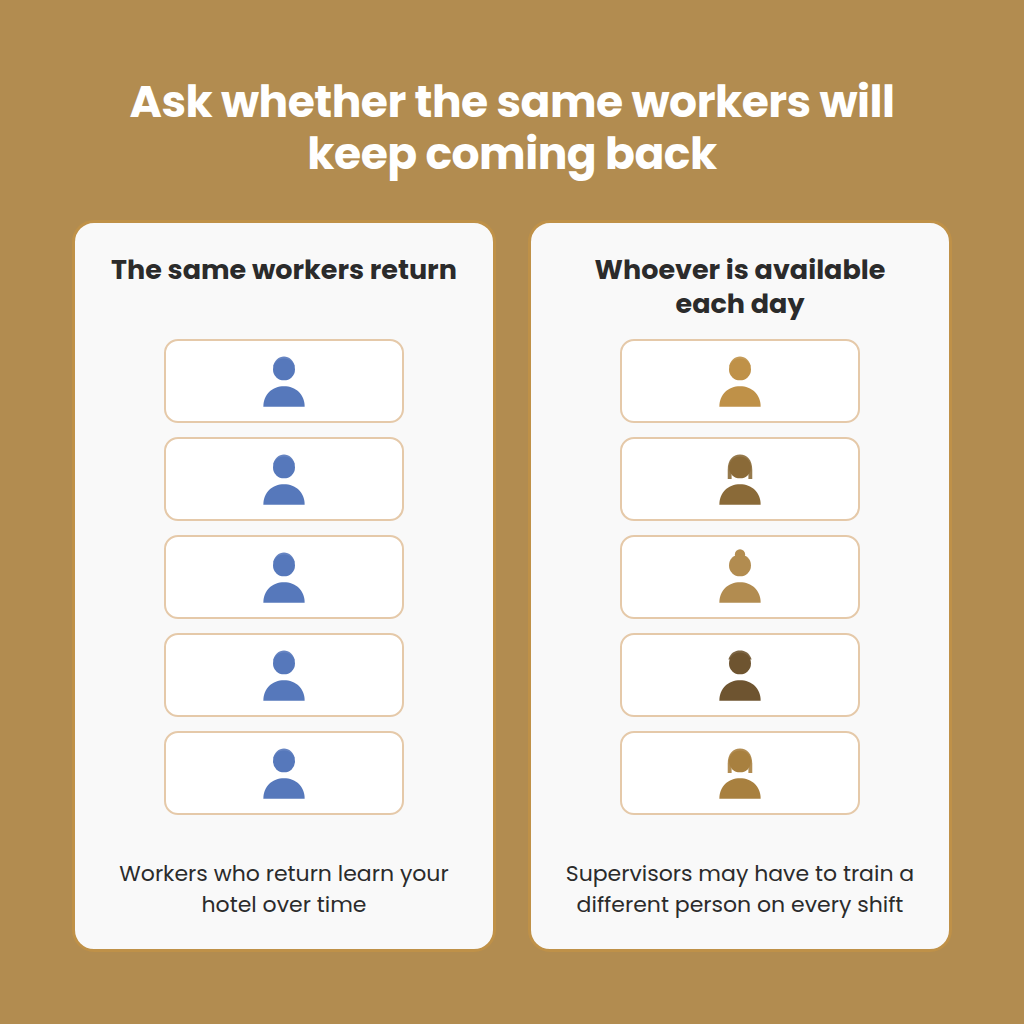
Training should also be specific to your property. Ask whether workers receive an orientation to your hotel before their first shift, covering your layout, your standards, and who they report to. Then ask whether the same workers will keep coming back to your property. Workers who return learn your hotel over time, and your supervisors spend less time training someone new. If an agency sends whoever is available each day, your supervisors may have to train a different person on every shift.
Pricing and contracts
How is your bill rate calculated, and what does it include?
The bill rate is the hourly amount a staffing agency charges your hotel for each worker. The worker’s own wage, called the pay rate, is one part of that bill rate. The difference between the two is often called the markup. The markup pays for the costs of employing the worker, such as payroll taxes, benefits, and insurance. It also covers the agency’s own costs, such as recruiting, management, and general overhead.
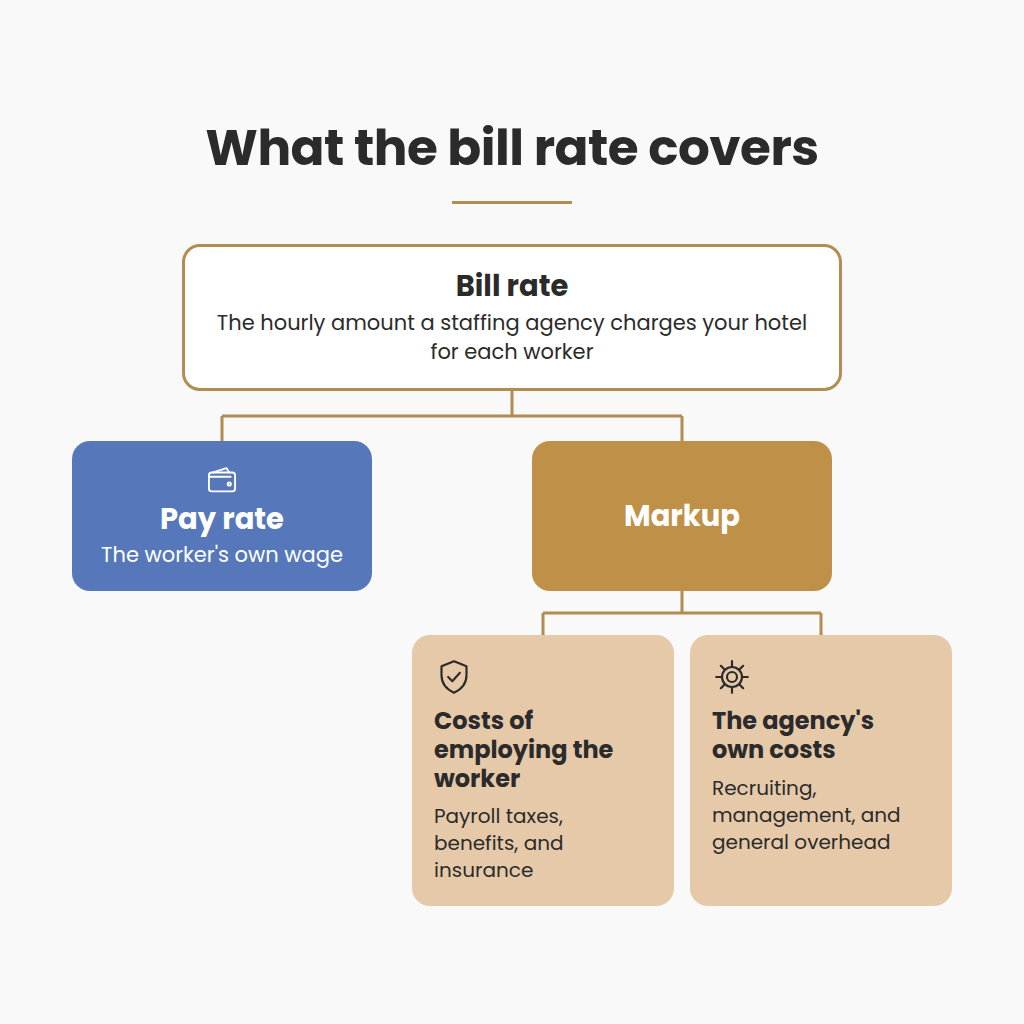
The markup has to cover payroll taxes at a minimum. As the employer, the agency pays 7.65% of each worker’s wages toward Social Security and Medicare. If a bill rate sits only slightly above the pay rate, ask how the agency covers its costs. A markup that small may not leave enough to pay for insurance, screening, and the agency’s other costs.
The agency should be willing to show you the pay rate, explain what the rest of the bill rate covers, and tell you whether anything is billed separately. When you compare agencies, compare the total cost of a shift or a month, including any fees, because a lower hourly rate can come with extra charges that raise the total. If an agency will not explain what its bill rate covers, you have no way to tell what a lower price leaves out.
What fees, minimums, and contract terms should I expect?
Fees and contract terms decide what you pay beyond the bill rate and how easily you can end the agreement. You can negotiate them, so treat an agency’s first answer as a starting point. Ask these questions on the call:
- Do you bill a minimum number of hours per shift, even when I send a worker home early?
- What rate applies when a worker goes into overtime or works a holiday?
- How do workers record their hours, and who at my hotel approves them before you bill me?
- How much notice do I need to give to cancel a shift without being charged?
- Do you charge a fee if I hire one of your workers onto my own staff, and when does that fee stop applying?
- How long does the contract run, does it renew automatically, and how much notice do I need to give to end it?
Good billing terms mean your hotel pays only for the hours your managers approved. Overtime should be billed only when a manager approved it in advance. Recorded hours should reach your manager for sign-off before the invoice goes out. You should also have a clear way to dispute an hour you did not approve. If the agency bills a minimum number of hours per shift, the contract should state that number.
Good contract terms let you change your schedule and end the agreement without unexpected costs. The notice needed to cancel a shift should be shorter than how far ahead your hotel builds its schedule. That way, you can still cancel a shift in time once your schedule shows you do not need it. The direct-hire fee, which you pay if you hire an agency worker onto your own staff, should stop applying after a period the contract states. The contract should also let you end the agreement with written notice. Get the final version of every term in writing before you sign. A fee in the contract that never came up on the call is a reason to read the rest of the contract closely.
Reliability and coverage
How quickly can you fill a request?
Fill times depend on whether you need ongoing help or short-notice coverage. Ask the agency how long it takes to fill an ongoing need, such as extra room attendants for your busy season. Then ask how quickly it can cover a short-notice request, such as a banquet server to replace someone who called off this morning. In our experience, an ongoing need takes two to three weeks to fill, including screening and training. Same-day or next-day coverage is possible only when an agency already has screened, trained workers available.
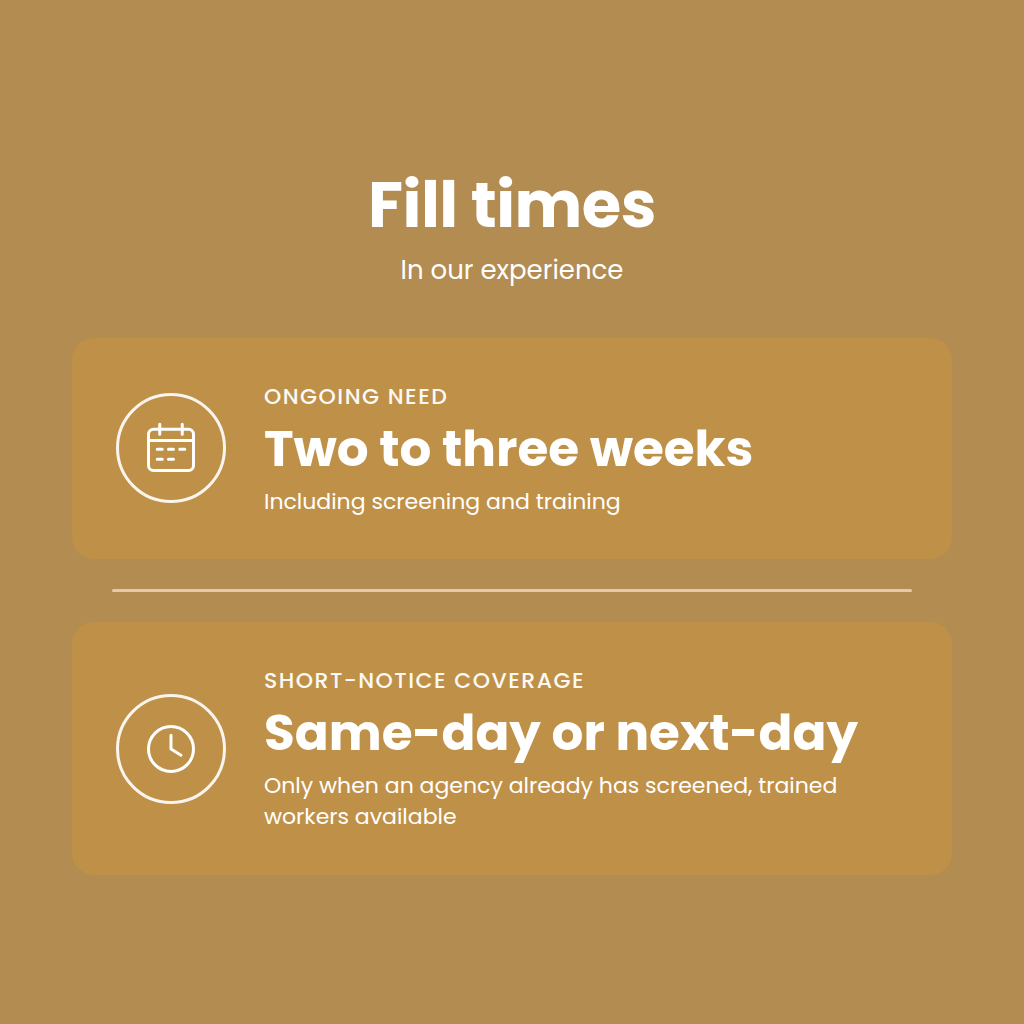
If an agency quotes a next-day start for a new ongoing role, ask what that timeline includes. Workers for a new ongoing role still need to be chosen and trained for your property. If you often need coverage on short notice, ask how the agency handles emergency hotel staffing requests in your area.
Ask about fill rate as well as speed. Fill rate is the share of requests the agency actually fills. Also ask how the agency tells you when it cannot fill a request, so your managers are not counting on a worker who is not coming.
What happens if a worker doesn’t show up or isn’t a good fit?
A no-show is hardest on your team when the hotel is busy, such as when a room attendant misses a 7 a.m. shift after a sold-out night. Unless a replacement arrives quickly, your own managers may have to clean the rooms that attendant was assigned. The agency’s answer should tell you who you call, how it finds a replacement, and how quickly a replacement usually arrives. Ask whether the agency keeps backup staff available for last-minute call-offs. An agency without backup staff has to start looking for someone after you call, so it cannot commit to sending a replacement.
The same question applies when a worker arrives but is not a good fit for your property. A good agency sends a replacement when you ask, and it finds out what did not work so the next worker is a better match.
Ask how the agency bills a shift that goes wrong. Find out whether you pay for the hours already worked by someone who was not a good fit. Then ask whether a replacement is billed from the time the replacement arrives or from the original start time. Billing that starts when the replacement arrives means you do not pay for the time your hotel spent waiting.
How do you keep your workers from leaving?
An agency can keep sending you the same trained workers only if those workers stay with the agency. Listen for specifics about what the agency offers its workers: the pay, benefits such as health insurance and paid time off, and raises that reward longer service. An agency that pays attention to retention can also tell you how long its workers typically stay. If the agency’s only answer is that it is always recruiting, ask what it does to keep the workers it already has.
Communication and support
Who is my point of contact, and how often will they visit?
A good agency answers this question with the name of the manager who will handle your account and a visit schedule it will put in writing. One named contact knows your hotel and your history with the agency, so you do not have to explain a problem to someone new each time you call.
Visits matter because quality problems are easier to spot in person. A manager who walks your property can see how the work looks, talk with your supervisors, and check in with the workers before a small issue becomes a larger one. If the agency visits only after something has gone wrong, no one from the agency is checking quality before your guests notice a problem.
How do I reach you after hours?
A replacement plan only helps if someone at the agency answers when you call at 5 a.m. on a Sunday or in the middle of an overnight shift. Ask exactly who answers the phone while the agency’s office is closed and how quickly they respond.
What you want is a phone number that reaches a person for urgent issues at any hour. General questions, such as a billing question, can reasonably wait for regular business hours, as long as the agency tells you so in advance. Before you sign, call the after-hours number once to see who answers. If the after-hours line only takes a message, you will be handling any urgent problem on your own until someone calls back.
Questions to bring to your first call
Bring these questions to each first call, and write down every agency’s answers so you can compare them afterward.
| Question | What a strong answer includes | Red flag |
|---|---|---|
| Do you specialize in hotels? | The hotel departments and roles the agency staffs, and the property types it serves | Says it staffs any industry but cannot name the hotel roles it fills most |
| Can you share references from hotels like mine? | References from hotels of a similar type and size, with managers you can call | Only written testimonials or references from other industries |
| Are your workers W-2 employees? | W-2 employees, with the agency as employer of record handling payroll and tax withholding | Cannot say clearly who employs its workers |
| Who carries workers’ compensation and liability insurance? | Workers’ compensation for every worker, named coverage for damage to hotel property or guest belongings, and a certificate of insurance before the first shift | Says only “we’re insured,” or has no current certificate of insurance |
| How do you screen workers before they arrive? | Background checks with written consent, work eligibility verification, reference checks, and skills checks | Describes screening in general terms without naming any checks |
| Are your workers trained for hotel work and for my property? | Hotel service training, required certifications, an orientation to your property, and the same workers returning | Sends whoever is available, so a new person arrives for each shift |
| How is your bill rate calculated, and what does it include? | The worker’s pay rate, plus what the rest of the bill rate covers | Will not explain what the bill rate covers |
| What fees, minimums, and contract terms should I expect? | Billing only for hours your managers approved, and written terms for cancellations, direct-hire fees, and ending the contract | Fees in the contract that never came up on the call |
| How quickly can you fill a request? | Separate timelines for ongoing and short-notice requests, and the share of requests the agency fills | A next-day start for a new ongoing role, with no explanation of how workers will be chosen and trained that quickly |
| What happens if a worker doesn’t show up or isn’t a good fit? | A clear replacement process, backup staff for last-minute call-offs, and replacements billed from the time they arrive | No backup staff, so the agency cannot commit to sending a replacement |
| How do you keep your workers from leaving? | The pay, benefits, and raises the agency offers workers who stay, and how long its workers typically stay | No retention plan beyond hiring replacements |
| Who is my point of contact, and how often will they visit? | A named manager, a regular visit schedule in writing, and quality check-ins with your supervisors | Visits only after something goes wrong |
| How do I reach you after hours? | A person who answers urgent calls at any hour, with general questions handled during business hours | An after-hours line that only takes messages |
What hotels can expect from Tumi Hospitality
Every worker we place through our hotel staffing services is a W-2 employee of Tumi Hospitality, with health, dental, and life insurance and paid time off. We screen every candidate before you meet them. Each new hire completes training specific to your property. All of our employees are covered by workers’ compensation insurance, and you receive a certificate of insurance before anyone starts at your hotel.
An area manager visits your property every week. We keep backup staff available for last-minute call-offs, so your managers do not have to cover those shifts themselves. We offer on-call customer service for urgent issues, around the clock. General inquiries are handled during standard business hours.
The invoice we send is the full amount you pay, with no fees or charges billed separately. Hotels we work with typically see 12-18% annual savings on hard employment costs. These are the costs a hotel carries when it employs staff itself, such as payroll taxes, insurance, benefits, and recruiting. Our longest client relationship began in 2005.
If you are comparing staffing companies now, we would be glad to answer these questions for your property. Contact us to request a no-obligation consultation, call us at (512) 722-6000, or email info@tumihospitality.com. We will talk through your staffing needs and prepare a proposal for your hotel.