

Plan on roughly 1.25 to 1.45 times the base hourly wage for every position your Indianapolis hotel carries in 2026. Payroll taxes, workers compensation, insurance, and paid time off together add 23.5 cents on top of every dollar of wages, and you pay that whether anyone leaves or not. Recruiting, training, and replacing people is what moves a position from the bottom of the range to the top. At the Indianapolis metro median wage for a housekeeper, which is $15.69 an hour, one full-time position costs about $40,700 a year if the same person stays all year, and about $46,800 if the position turns over at the pace this industry runs.
At Tumi Hospitality, we have staffed hotels in the Indianapolis market for more than eight years, including a full-service property here that uses us as its only outside staffing provider. Most operators we work with know their hourly rates exactly, because they sign the timesheets every week. The costs that catch them are the ones that never show up on a timesheet.
What hotel roles pay in the Indianapolis metro
Every loaded cost starts with a wage, so start with what this market pays. The figures below come from federal wage data for the Indianapolis metro area, published for the Indianapolis-Carmel-Greenwood metropolitan area.
| Role | Median hourly wage | Metro range (10th to 90th percentile) | Loaded cost per hour at 1.25x to 1.45x |
|---|---|---|---|
| Housekeeper or room attendant | $15.69 | $13.98 to $19.50 | $19.61 to $22.75 |
| Front desk agent | $16.59 | $14.04 to $18.01 | $20.74 to $24.06 |
| Laundry attendant | $14.92 | $13.41 to $17.65 | $18.65 to $21.63 |
| Cook | $17.60 | $12.94 to $21.78 | $22.00 to $25.52 |
| Maintenance technician | $23.81 | $16.94 to $37.04 | $29.76 to $34.52 |
| Lodging manager | $35.94 | $22.18 to $51.30 | $44.93 to $52.11 |
Two things to know before you use those figures. The last column applies the 1.25 and 1.45 multipliers to each median as a quick reference. Adding up the actual cost lines one at a time gives a slightly different answer: for the housekeeping position it comes out at $19.57 and $22.50, a few cents off the last column.
More important for a 2026 budget: this wage data was collected in May 2025, and it is the most recent metro-level wage data published. Hotel labor costs have risen since it was gathered, so budget a little above these figures and check them against what properties near you are posting this month.
The range matters more than the median here, because a downtown full-service hotel and a suburban select-service property are budgeting to different points on it. Housekeeping is the clearest example. The metro spread runs from $13.98 to $19.50 an hour, which is a difference of about $11,500 a year per person in wages alone, before any of the loads. A property competing for room attendants against downtown hotels and the convention calendar should budget above the median. A select-service property near the airport or off an interstate exit has more room to sit at or below it.
Setting the salaried lodging manager row aside, maintenance carries the widest spread of the hourly positions, from $16.94 to $37.04. The title covers everything from a general handyman to a licensed technician, so pick your point on that range by the work you actually need done. The lodging manager row comes from a small sample for this metro, so treat it as a rough guide.
What one housekeeping position costs for a full year
Here is the whole thing in one place, for one room attendant working full time at the Indianapolis metro median of $15.69 an hour. At 2,080 hours a year, that is $32,635 in base wages. That is the number on the timesheet. Everything under it is what the timesheet does not show.
| Budget line | Annual cost | Where it comes from |
|---|---|---|
| Base wages | $32,635 | 2,080 hours at the metro median of $15.69 |
| Employer FICA | $2,497 | 7.65 percent of wages |
| Federal unemployment tax | $42 | The most this tax can reach per employee in a year |
| Indiana unemployment insurance | $238 | 2.5 percent of the first $9,500 of wages |
| Workers compensation | $255 | 78 cents per $100 of payroll |
| Insurance, paid time off, and holiday pay | $4,637 | The full 23.5 cent benefits load per wage dollar, less the four lines above |
| Position with nobody leaving | $40,304 | Wages plus 23.5 cents per wage dollar |
| Replacement cost if the person stays about three years | $411 | $1,233 per hire, spread across three years |
| Loaded cost, stable position | $40,715 | 1.25 times wages, or $19.57 an hour |
| Replacement cost at the industry turnover pace instead | $6,500 | $9,800 per departure at two thirds of a departure a year, which is $6,533 rounded down |
| Loaded cost, position that turns over | $46,804 | 1.43 times wages, or $22.50 an hour |
Do not add those last two lines together. They are two versions of the same position, so pick the one that matches yours. Those two totals work out to 1.25 and 1.43 times the wage. The bottom of the range is a position that keeps the same person all year, and 1.43 is a position turning over at the pace this industry runs. The top of the 1.25 to 1.45 range covers a position you refill more than once in a single year.
Each of those lines has its own drivers. Here is where each one comes from, what moves it at your property, and how to run the same arithmetic for your other positions.
Payroll taxes: what the employer side adds
Payroll taxes are the easiest line to get right, because the rates are published and you have no say in most of them.
FICA costs you 7.65 percent of wages, made up of 6.2 percent for Social Security and 1.45 percent for Medicare. On a full-time housekeeper at the metro median, that is about $2,497 a year.
Federal unemployment tax adds at most $42 per employee per year once the standard state credit is applied. Any full-time position reaches that cap, so budget $42 and leave the line alone.
Indiana unemployment insurance is the line that actually varies between properties. The state taxable wage base is the first $9,500 of each employee’s wages per year, and employers in good standing run anywhere from 0.50 percent to 7.40 percent, which works out to somewhere between $47.50 and $703 per employee per year. Where you land on that schedule is set by your own history of claims against your account. A brand new employer in Indiana is assigned a standard rate of 2.5 percent for its first four calendar years, or about $238 per employee, which is the figure the build above uses.
Add those three together and payroll taxes come to roughly 8 to 10 percent of wages for most hotels. A property with a clean unemployment history sits at the bottom of that range. A property that has run layoffs or seasonal reductions sits at the top, and that difference is worth about $655 a year per employee.
Workers compensation for hotel roles
Workers compensation is priced per $100 of payroll and assigned by job classification rather than by person. Indiana’s advisory rate for the hotel classification is 78 cents per $100 of payroll, and 77 cents for hotel restaurant employees, both set after a 7.2 percent cut to statewide advisory rates effective January 1, 2025. On a housekeeper earning the metro median, that is about $255 a year, so the starting point is lower than it was.
You will pay more than that advisory rate. Three things move your property’s actual cost above it. The first is your experience modification factor, which is set by your own claims history against what is expected for a hotel your size. How often you have claims moves it more than how expensive any single claim was. The second is which classification your payroll falls into. Housekeeping and maintenance are physical jobs with lifting, chemicals, and ladders, so they carry higher rates than a front desk position, and your mix of the two sets your blended cost. The third is your carrier’s own multiplier, which it applies on top of the state figure to set what you actually pay.
For budgeting, use the advisory rate as your baseline and then adjust it with your actual premium and your current modification factor, both of which your broker can give you. If you have had claims in housekeeping recently, budget above the baseline, because the modification factor reflects your claims history and does not reset the moment the claims stop.
Benefits and paid time off
Indiana does not require you to offer any of this. State law requires only that employers pay employees for time actually worked, with no mandate for sick days, personal days, vacation, or holidays, and no requirement to provide health insurance or a retirement plan. Federal law takes the same position on paid time off, sick leave, and holiday pay: the Fair Labor Standards Act does not require payment for time not worked. So every hour of paid time off on your books is a decision you made to compete for people, and it belongs in the budget as a real cost.
Budget this as a percentage of wages, because a dollar figure from one property does not carry over to another. Across the leisure and hospitality industry, benefits of all kinds run about 19 percent of total compensation, with wages making up the other 81 percent, against 30 percent of total compensation for private industry as a whole. Turned around into something you can apply to a wage, that is 23.5 cents of benefits cost for every dollar of wages, and it means hospitality carries a lighter benefits load than most industries do.
Those 23.5 cents already include payroll taxes and workers compensation along with insurance and paid leave. Payroll taxes and workers compensation account for 9.3 of the cents, which leaves 14.2 cents for insurance, paid time off, and holiday pay. Use one route or the other when you build a number. Either apply 23.5 cents per wage dollar once and stop there, or list payroll taxes and workers compensation as their own lines and add 14.2 cents per wage dollar on top of them. Running both counts the same money twice and inflates your labor budget by 9.3 percent of payroll.
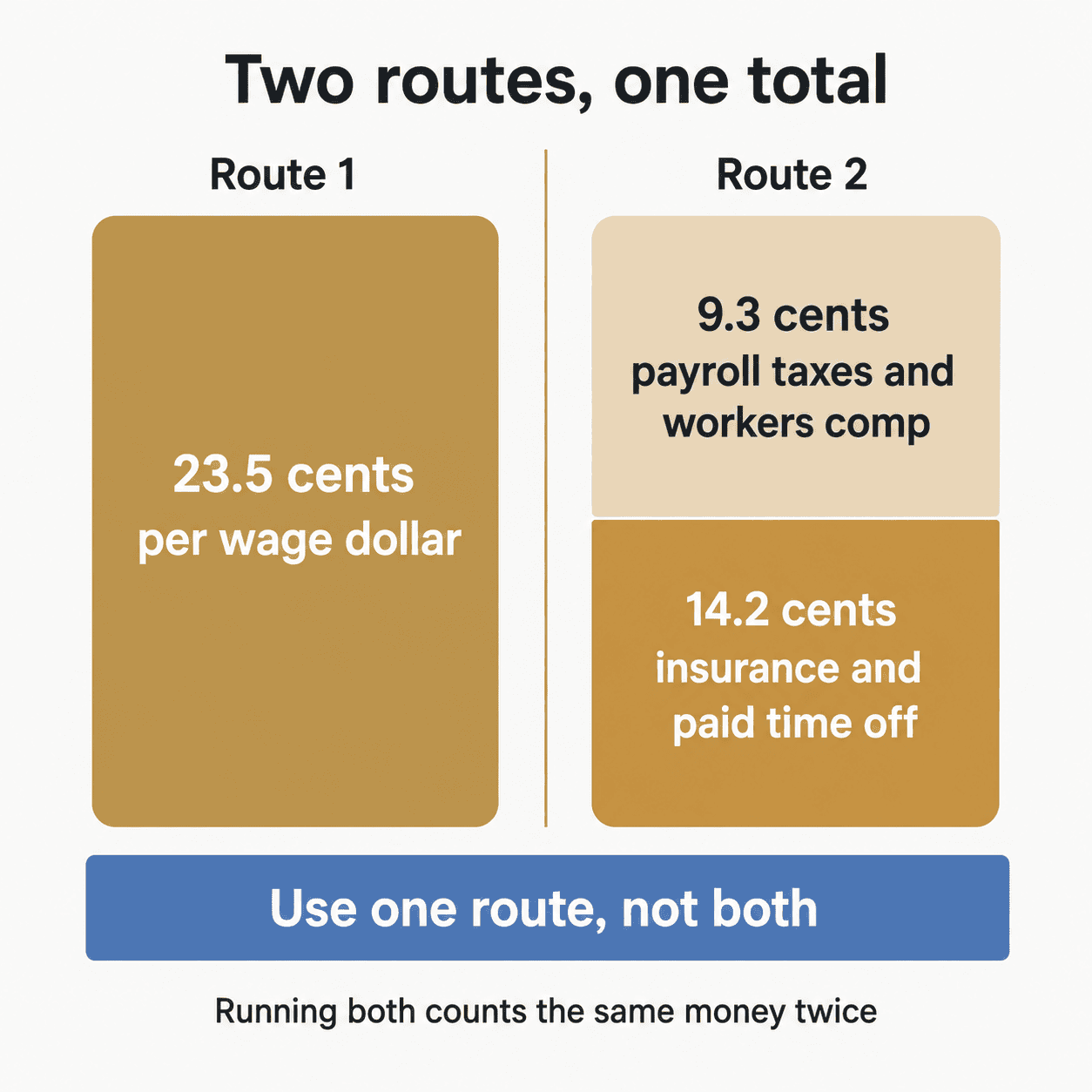
Where you land depends on what you offer. A property with health, dental, and life insurance plus PTO and holiday pay is at the full 23.5 cents. A property offering little beyond what the law requires is closer to 9.3 cents, since payroll taxes and workers compensation are most of what is left. Even that leaner property stays above the 1.25 floor. The floor assumes a position that mostly stays filled. Once you add replacement cost at the industry turnover pace, a property carrying only the statutory 9.3 cents lands around 1.29 times the wage. A leaner benefits package lowers that one line and leaves the turnover line where it was.
What it costs to recruit and hire one person
Recruiting rarely gets a line of its own in a hotel budget. Four things go into it:
- Advertising the opening. This is a job board posting, a sponsored listing, or local advertising, and it comes with an invoice you can look up.
- Manager hours. Your department head spends them screening applications, calling candidates who do not answer, scheduling interviews, and sitting in on them.
- A background check. This also arrives as an invoice, so price it from your own records.
- Onboarding paperwork. Someone on your payroll has to handle the I-9, the tax forms, the direct deposit setup, and the handbook.
The manager hours are the piece that goes uncounted, and they are usually the largest of the four. You can price them from published wage data. The Indianapolis metro median for lodging managers is $35.94 an hour, so eight hours of your department head’s time on one opening comes to about $288. Eight hours is easy to reach once you add up application review, phone calls, scheduling, and the interviews where the candidate never arrives. Those are hours your executive housekeeper did not spend inspecting rooms, and you paid for them either way.
What it costs to train someone before they are productive
There are two costs in training, and most budgets miss both of them.
The first is the new hire. A room attendant is on your payroll from her first day, but she is not cleaning a full board of rooms on her first day. The gap between what you pay her and what she produces during that ramp is a real cost, and it runs until she is at standard.
The second is the person doing the training. Your strongest room attendant or your supervisor is spending part of her day teaching, which means she is not doing her own work at full speed either. You are paying two people to produce roughly one person’s output for as long as the training runs.
Put a number on it with your own wage figures. At the Indianapolis metro median of $15.69 an hour, a new room attendant costs about $126 for each eight-hour day she is on payroll before she is up to speed. A five-day ramp is about $630. Then add the trainer. If your experienced room attendant gives up half of those five days to teaching, that is another $315. So a five-day ramp on one housekeeping position costs about $945 in wages paid for work that did not get done.
Change the ramp length to match your own property. The arithmetic above assumes five days. If your front desk ramp runs two weeks, run the same calculation on ten days, plus the trainer’s share of them.
Put recruiting and training together and one housekeeping hire costs $1,233 you can count: $288 in manager time plus $945 in ramp. That is before your advertising and background check invoices, and it is the $1,233 in the table above.

How turnover multiplies your recruiting and training cost
Payroll taxes, workers compensation, and benefits cost the same whether a person stays one year or five. Recruiting and training cost you again every time the position empties, and how often that happens is what separates the bottom of the 1.25 to 1.45 range from the top.
Accommodation and food services averaged a monthly separations rate of 5.5 percent in 2025, against 3.6 percent for private industry overall. At 5.5 percent a month, separations across a full year come to roughly two thirds of headcount, so budget to refill about two of every three hourly positions in a year.

That rate covers hotels and restaurants together, which is the closest published figure for the labor market you hire from. No published series separates lodging from food service, so treat the blended rate as a proxy rather than a precise read on hotels alone. In a labor budget, overestimating turnover is safer than underestimating it, and the top of the range is built on that assumption.
For what one departure costs, the working estimate industry groups apply is up to 30 percent of that employee’s annual pay, covering recruiting, training time, and lost production. For a housekeeper at the Indianapolis metro median, whose annual wages come to $32,635, that ceiling is about $9,800 per departure.
Two things are worth saying about that $9,800, because it is the figure that gets misread most often. First, it covers advertising, manager time, ramp, and production you did not get, expressed as a percentage of pay because those costs scale with the role. You are not paying anyone $9,800 in extra wages. Second, it is an additional cost that sits on top of the wage and the compensation loads.
How you set the budget line depends on what you know about the position. If you have your own turnover history for it, multiply $9,800 by the number of times you expect to fill it this year. With no history to work from, carry about $6,500 a year for a housekeeping position, which is that ceiling at the industry’s two-thirds pace. The $1,233 from the recruiting and training arithmetic is the low end of the same estimate. It counts only what you can invoice and schedule, while the $9,800 ceiling also counts the rooms that did not get cleaned on time. Our breakdown of the real cost of hotel employee turnover goes further into where that gap comes from.
Budgeting for Indianapolis peak weeks in 2026
Two things about this market change what you should budget for 2026. Both of them show up in the weeks when you are short staffed.
Downtown is adding capacity. Signia by Hilton Indianapolis, an 800 room convention headquarters hotel, is on track to open in fall 2026, and the Indiana Convention Center is finishing a 143,500 square foot expansion on the same timeline. That is 800 rooms’ worth of new hiring drawing from the pool your housekeeping department hires from. Leisure and hospitality employment across the Indianapolis metro was 113,100 in June 2026, so that hiring is a small share of the metro workforce. Those jobs will not be spread across the metro, though. They are downtown, and they are the same hourly roles you fill.
The event calendar is the second piece. The city hosts its ninth NCAA Men’s Final Four in 2026 along with the ASAE annual meeting. Events like those do not spread demand evenly across the year. They concentrate it into a handful of weeks, and those weeks are where a labor budget goes over, because you cover them with overtime and call-ins that were not in the headcount you planned in October.
You can budget that. Hours past 40 in a week are paid at no less than time and a half, so at the metro median housekeeping wage of $15.69, an overtime hour costs $23.54 instead of $15.69. The premium is $7.85 an hour on top of what you would have paid anyway. The same 9.3 cents of payroll taxes and workers compensation apply to that premium, which brings the true extra cost to about $8.60 an hour. Insurance and paid time off do not scale with overtime hours, so leave those out.

Then count the hours. Pull last year’s schedule and find the weeks housekeeping went past 40. As an illustration, a department running 120 overtime hours in each of ten peak weeks is 1,200 hours at about $8.60, or roughly $10,300 a year that appears nowhere in a per-position budget. Run the same count for the front desk and for maintenance, and give the total its own budget line. With a new convention headquarters hotel and a Final Four on the 2026 calendar, budget more overtime hours in 2026 than you used in 2025.
Labor cost per occupied room, and what to tell an owner who asks for a percentage
When you bring your budget to an owner or an asset manager, the number they will ask about is labor cost per occupied room. It is your total labor cost for a period divided by the number of occupied rooms you sold in that period, and it is the figure that lets them compare your property against others. Work it out before that meeting.
Across roughly 5,000 United States hotels, labor cost per occupied room averaged $46.79 in the first quarter of 2026, up 1.8 percent from the year before. That blended average covers a wide spread. In the same report, full-service hotels ran $59.73 per occupied room. Select-service hotels ran $30.36.

Those are two different businesses. A downtown full-service property with a restaurant, banquets, and a convention calendar should be checking itself against the $59.73 figure. A select-service property near the airport should be checking against $30.36. Checking either one against the blended average will give you a misleading read on your own costs.
The trend matters as much as the level. For all of 2025, labor cost per occupied room averaged $48.32, up 12.8 percent from $42.82 in 2024. The first quarter of 2026 grew far more slowly, at 1.8 percent, so the pace has cooled. Even so, building a 2026 budget flat against last year’s per room figure is likely to leave you short.
Connecting one position to the per occupied room figure
A loaded position cost and a per occupied room figure look like two different measurements. Getting from one to the other is division. Add up the loaded cost of every position across every department, add your overtime line, and divide the total by the occupied rooms you forecast for the year. That result is the figure to set against the benchmark for your property type.
Running it backward is the faster sanity check. A full-service property forecasting 40,000 occupied rooms at the $59.73 benchmark has a labor budget of about $2.39 million. At the $40,715 the housekeeping build above costs when the position stays filled, that budget supports about 59 positions. At the $46,804 it costs when the position is refilled at the sector pace, it supports about 51. If your org chart calls for meaningfully more than those counts, you are either running above the benchmark or your positions average less than a housekeeper costs. Either way, it is worth knowing before an owner asks.
If an owner asks for labor as a percentage of revenue
Tell them there is no current, credible published benchmark for it. The figures still in circulation are more than a decade old, and both wages and hotel revenue have moved too much since then for those numbers to mean anything. Offer two things in its place. The first is your cost per occupied room against the benchmark for your property type, which is published quarterly and is what other operators are actually comparing themselves to. The second is your own property’s trailing twelve months. Comparing your property against its own recent history is fair even when comparing it against a national average is not. Together those two answer what the owner wants to know, which is whether your labor cost is under control and moving in the right direction.
How a staffing partner changes the math
Once you have a loaded number, you can make an honest comparison against what a staffing partner charges. Most of these comparisons go wrong in the first step, when a property sets a partner’s bill rate next to a bare hourly wage. A bill rate already includes payroll taxes, insurance, and the rest of the loads, so it is not measuring the same thing as a wage.
So when you ask a partner for a rate, compare it against your loaded hourly cost for that role. For the housekeeping position above, that means $19.57 if the position keeps the same person all year and $22.50 if it turns over. Setting a quoted rate against the $15.69 wage will make any partner look expensive. Rates move with the role, the volume, and the property, so the only rate worth comparing is the one on your own quote.
Here is how the cost lines split between the two models.
| Cost line | Hiring directly | With a W-2 staffing partner |
|---|---|---|
| Base wages and payroll processing | Both sit on your books | Included in the billed rate |
| Employer payroll taxes (FICA, FUTA, Indiana UI) | You pay them, and your own claims history sets your Indiana rate | Included in the billed rate |
| Workers compensation | You pay the premium, and your claims raise your future rate | Carried by the partner |
| Insurance, paid time off, and holiday pay | You fund whatever you choose to offer | Carried by the partner |
| Advertising, screening hours, background checks, onboarding | You pay these, mostly in manager time | Carried by the partner |
| Refilling the position when someone leaves | You repeat the whole cycle | Carried by the partner |
With a staffing partner, those costs arrive as one hourly rate on one invoice. The cost is also steadier year to year, because an unemployment claim or a workers compensation claim on a partner’s employee does not raise your rates the following year.
Across our client properties, hotels that move to our staffing typically see 12 to 18 percent in annual savings on hard employment costs once they compare their total cost of employment against our billed rate. That range comes from our own client experience, and where a given property lands in it depends on what it was carrying before. The people we place are W-2 employees, and our full-time placements carry health, dental, and life insurance and paid time off. Those costs sit inside the rate we quote, so nothing for taxes, insurance, or benefits gets added on top of it. If the employment structure itself is new to you, we explain what W-2 employment means in hospitality separately.
Most properties start with housekeeping staffing, since it is the largest hourly department and the one where turnover costs the most, and expand from there across other hotel departments.
How to build the number for your own positions
Work through these in order, one position at a time.
- Start with the wage you actually pay, multiplied by the hours you actually schedule. Use your own rate here. Use the metro median for a separate check, which is whether your rate is still competitive.
- Add the compensation load, using one route only. Either add 23.5 cents per wage dollar and stop, or list payroll taxes and workers compensation separately and add 14.2 cents per wage dollar for insurance and paid leave. Both routes reach the same total. Running both adds the same money twice.
- Add replacement cost, multiplied by how many times you expect to fill that position this year. With no turnover history to work from, about $6,500 is the working figure for a housekeeping position at the metro median.
- Add an overtime line for your peak weeks, counted across the department from last year’s schedule rather than estimated per position.
- Divide the property total by your forecast occupied rooms and compare against $59.73 for full-service or $30.36 for select-service. If you are far off in either direction, find out why before the owner asks.
That last step is what makes the budget defensible. A number you built line by line and then checked against what comparable hotels spend is one you can defend to an asset manager. If you are building a department from scratch or restructuring one, our guide to how to staff a hotel covers the headcount side of the same question.
Common questions about hotel labor budgets
Does the loaded cost multiplier apply to salaried managers too?
Mostly, with two differences. Payroll taxes, workers compensation, insurance, and paid time off all apply the same way, so the compensation load holds. But federal and Indiana unemployment taxes are capped at low wage bases, so they shrink as a share of a larger salary. And replacement cost is much larger in dollars, because the 30 percent estimate scales with pay. At the Indianapolis metro median for lodging managers, $35.94 an hour, one departure costs up to about $22,400.
Will laying someone off raise my labor costs next year?
It can. Indiana sets your unemployment insurance rate from your own claims history, and the schedule for employers in good standing runs from 0.50 percent to 7.40 percent of the first $9,500 of each employee’s wages. Moving from the bottom of that schedule to the top costs about $655 per employee per year, which on a 60 person hotel is roughly $39,000. Workers compensation behaves the same way through the experience modification factor.
Does a staffing agency cost more than hiring directly?
A staffing partner costs more per hour than the wage on the timesheet and often less than the fully loaded cost of the position. That is why the comparison has to be run against your loaded cost. Where a given property lands depends on how much it was already carrying. A hotel with full insurance, generous PTO, and a position that turns over twice a year has far more cost to move off its books than a hotel with lean benefits and a housekeeping team that stays.
Let’s talk about your property
Every hotel’s number is different, so treat the figures above as a starting point for your own operation. If you would like help working out what your positions actually cost today and what they would cost under a different model, we would be glad to walk through it with you. You can reach us through our Indianapolis hospitality staffing page, and we will start from your own wage, benefit, and turnover figures for the positions you are budgeting.


