

Each hotel position in Chicago costs much more than its hourly wage. In addition to pay, every employee costs you payroll taxes, workers’ compensation insurance, health and other benefits, the paid leave the city requires, and the cost of recruiting and training a replacement when someone leaves. Chicago also sets its own minimum wage, tipped wage and scheduling rules, which add to what an hourly position costs. Build your 2026 budget on the full cost of each position. If you are also considering a staffing partner, the full cost of each position is the number to compare with the partner’s bill.
At Tumi Hospitality, we have staffed hotels since 2005. When our hotel clients compare our bill with the full cost of hiring directly, they see savings of 12-18% a year on hard employment costs. Hard employment costs are the costs of employing staff directly, including payroll taxes, workers’ compensation, health, dental and life insurance, paid time off, HR staff time and overhead, recruiting and training, and the cost of replacing employees who leave.
What do hotel workers make in Chicago?
In May 2023, average hourly pay in the Chicago area for housekeepers, front desk clerks, cooks, dishwashers and maintenance workers ranged from about $16 to about $27 an hour. Chicago’s minimum wage has risen since then and is $17.05 an hour in 2026. The $17.05 minimum is now higher than the 2023 averages for dishwashers and front desk clerks, and slightly below the 2023 averages for housekeepers and cooks. Maintenance workers had the highest 2023 average of these jobs, well above the minimum. For many entry-level positions, the wage you budget will be the city minimum.
Pay has likely risen since 2023, so treat these averages as a rough guide to the Chicago market. The rates you pay today are the better starting point for each position’s budget. Check each rate against the city minimum before you use it. Servers who earn tips in hotel restaurants and at hotel banquets and events can be paid under Chicago’s separate tipped wage, which has a lower minimum for base pay.
What is Chicago’s minimum wage in 2026?
Chicago employers with four or more workers must pay at least $17.05 an hour, the rate that took effect July 1, 2026.
How the minimum wage rises each July
Chicago raises its minimum wage every July 1. The city ties each increase to inflation and caps it at 2.5% a year. Plan for a raise on July 1 each year for every employee you pay at the minimum. Chicago’s wage rates apply only to hotels inside city limits, so a hotel outside the city should check the wage rules for its own location.
Tipped wage for hotel restaurant and banquet servers
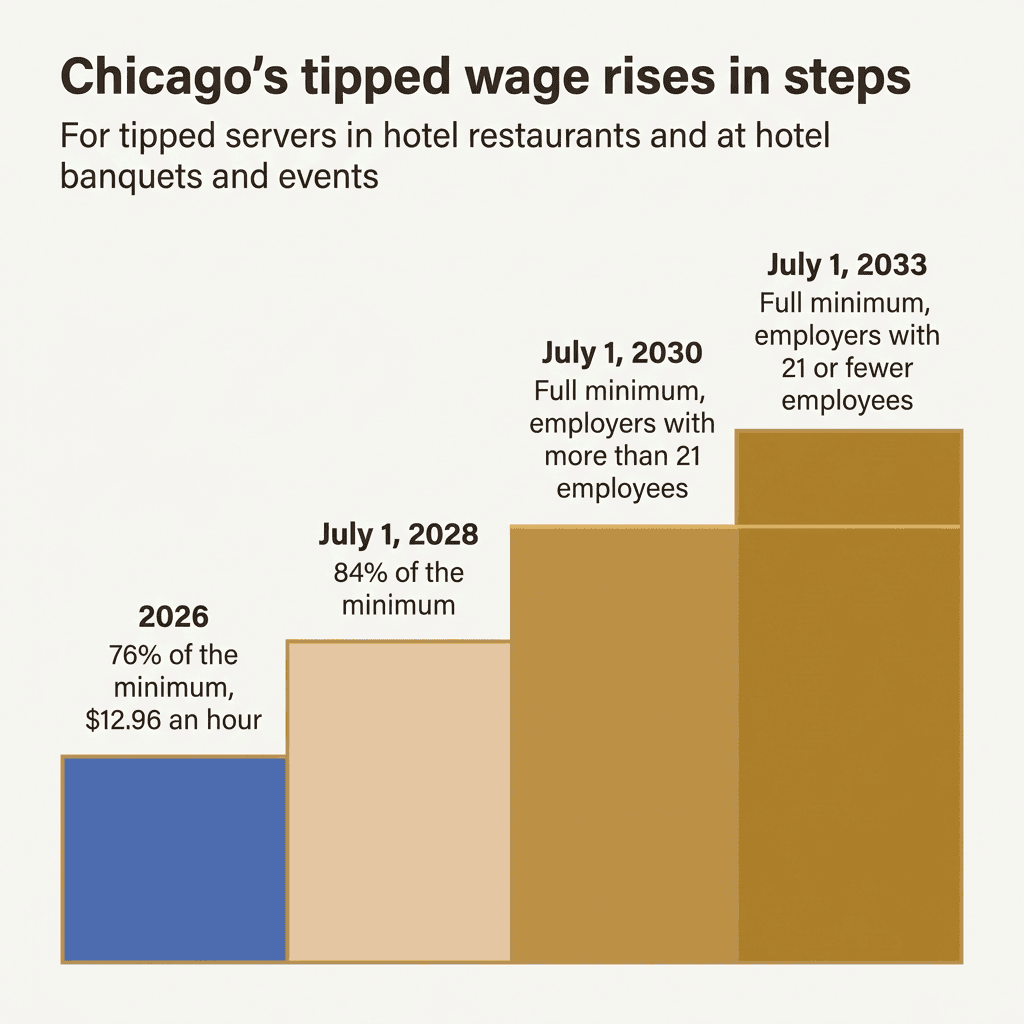
Servers who earn tips in hotel restaurants and at hotel banquets and events can be paid a lower base wage. In 2026, Chicago’s tipped wage is 76% of the full minimum wage, which comes to $12.96 an hour. Chicago is raising the tipped wage in steps until it matches the full minimum. In May 2026, the City Council delayed those steps. The next step, to 84% of the full minimum, now takes effect July 1, 2028. Employers with more than 21 employees must pay tipped staff the full minimum wage starting July 1, 2030. Employers with 21 or fewer employees have until July 1, 2033. Because the tipped wage is a share of the full minimum, it also rises with each annual increase.
Chicago paid leave and paid sick leave
Chicago requires employers to provide paid leave and paid sick leave. Each employee earns up to 40 hours of paid leave for any reason and up to 40 hours of paid sick leave a year, based on the hours they work. Part-time staff are covered once they work at least 80 hours for you within any 120-day period in Chicago. Together, the two kinds of leave add up to as many as 80 paid hours a year for each employee. For a full-time employee working 40 hours a week, 80 hours equals about 3.8% of a year’s pay. You also pay whoever works the shifts an employee misses while on leave.
Fair Workweek scheduling rules for hotels
Chicago’s Fair Workweek rules apply to hotels with at least 100 employees worldwide and at least 50 covered employees in Chicago. For a covered hotel, the rules set these requirements:
- Covered employees are those who earn $33.85 an hour or less in 2026, which includes most hourly hotel staff.
- Schedules must be posted 14 days in advance.
- A schedule change made with less than 14 days’ notice costs one extra hour of pay at the employee’s regular rate for each shift that changes.
- A shift cut or canceled with less than 24 hours’ notice costs half the employee’s regular pay for each hour they lose.
These extra payments are called predictability pay. Give predictability pay its own line in the budget, based on how often your schedules change after you post them.
What does a hotel employee cost beyond wages?
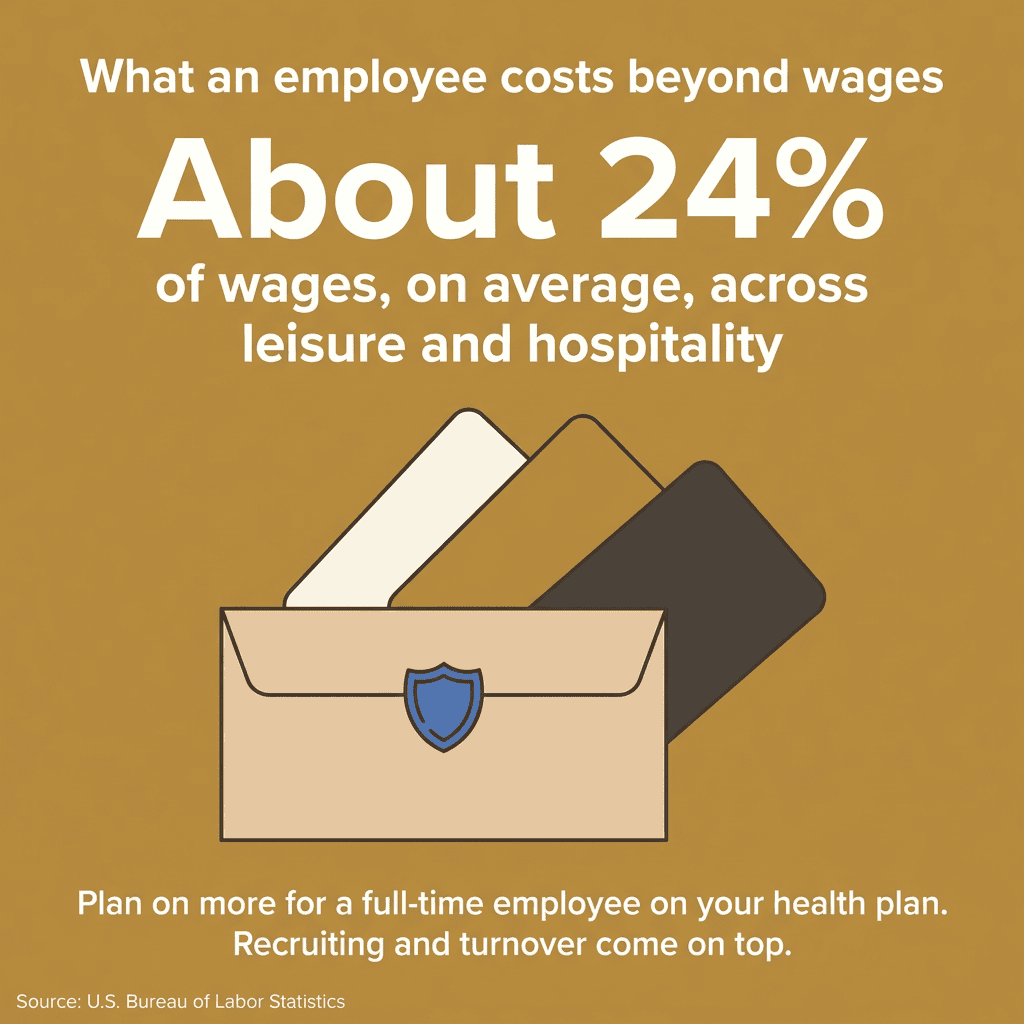
Across the leisure and hospitality industry, the costs of an employee beyond wages come to about 24% of wages. That figure is an average of full-time and part-time workers, so plan on more for a full-time employee enrolled in your health plan. Recruiting and turnover costs come on top of the 24%.
| Cost item | What it adds | Chicago or Illinois note |
|---|---|---|
| Social Security and Medicare | 7.65% of wages: 6.2% for Social Security and 1.45% for Medicare. | Social Security tax applies to the first $184,500 of each employee’s 2026 wages, so in practice it applies to all of an hourly employee’s pay. |
| Federal unemployment tax | 0.6% of the first $7,000 of each employee’s wages each year. The federal rate is 6%. Employers that pay their state unemployment tax on time and in full get a credit that lowers it to 0.6%. | Illinois employers currently get the full credit. The latest federal list of states with a reduced credit, published in January 2026 for the 2025 tax year, names only California and the U.S. Virgin Islands. |
| Illinois unemployment insurance | 3.35% for new employers in 2026, on the first $14,250 of each employee’s wages. | The 3.35% rate applies to employers that became required to pay Illinois unemployment tax on or after January 1, 2024. Hotels that were paying Illinois unemployment tax before 2024 use the rate the state assigns them each year. |
| Workers’ compensation insurance | A premium priced per $100 of payroll, with a separate rate for each job class. | Illinois law requires most employers to carry workers’ compensation insurance. Your insurer sets the rate, and your claims history can raise or lower it. |
| Health and other benefits | In our experience, health insurance costs a hotel $500 to $800 a month, and sometimes more, for each direct-hire employee on its plan. | The cost depends on the plan you offer and how many employees enroll. |
| Paid leave | Up to 40 hours of paid leave and up to 40 hours of paid sick leave per employee each year. | Chicago’s paid leave rules require this leave. |
Health and other benefits are usually the largest cost after wages. Each employee on your health plan adds a premium every month, whether the hotel is busy or slow, so build the benefits line from the number of employees you expect to enroll. We often see hotels underestimate benefits when they hire directly. Include dental and life insurance if you offer them, along with health coverage.
Federal and Illinois unemployment taxes apply only to the first part of each employee’s wages each year: $7,000 for the federal tax and $14,250 for the Illinois tax. Those limits start over with each new hire. A position that several people fill during the year therefore costs more in unemployment tax than a position one person holds all year.
What do recruiting, training and turnover add?
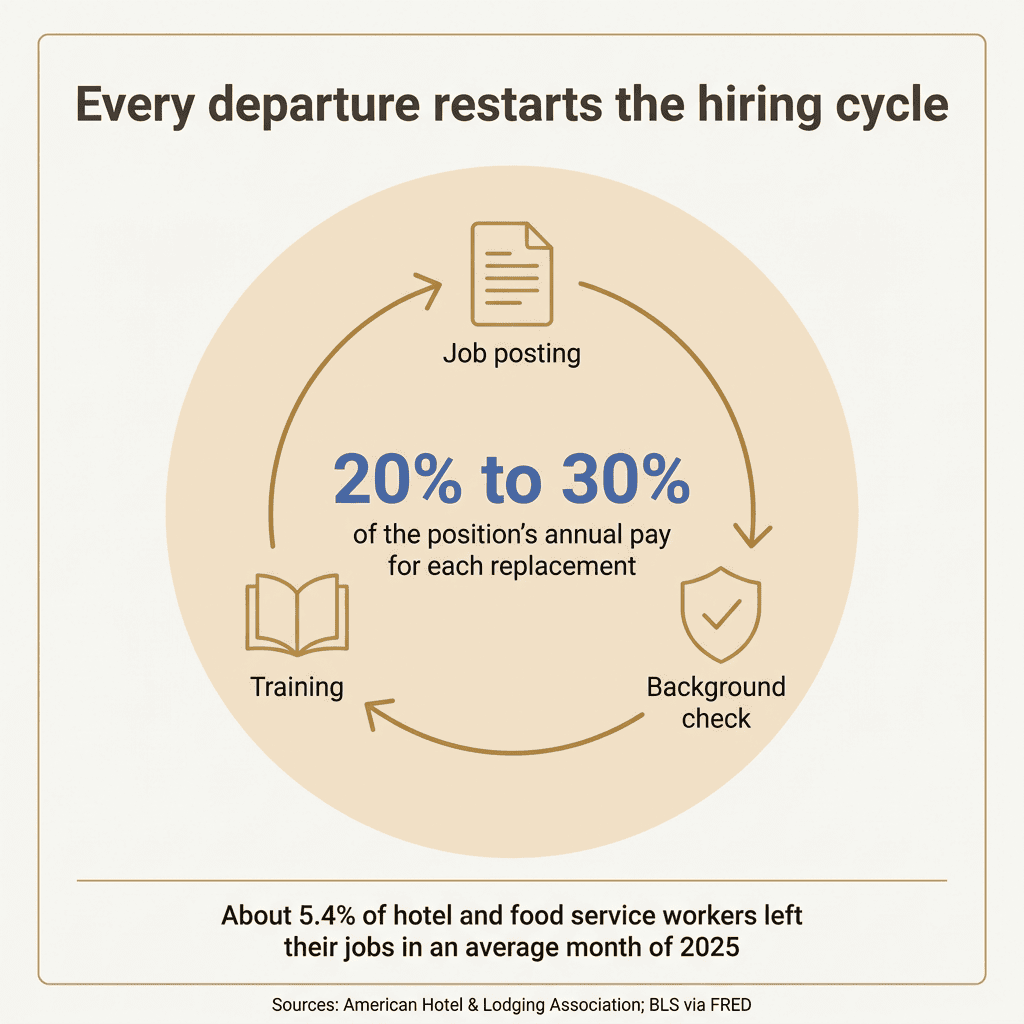
Each time a hotel employee leaves, replacing that person can cost up to 30% of their annual pay. The American Hotel & Lodging Association, the source of that figure, uses 20% of annual pay in its own example. Turnover is high across the whole hotel industry, so plan for it in your budget. In an average month of 2025, about 5.4% of workers in the hotel and food service industry left their jobs, whether they quit or were let go. Each departure starts the hiring cycle over, from the job posting and background check to training. In our experience, hotels often underestimate the staff time each replacement takes: the manager hours spent recruiting and interviewing, the HR time spent processing the new hire, and the time a new employee needs to learn your property. For a closer look at each of these costs, read our article on the real cost of hotel employee turnover.
How should a Chicago hotel budget for busy weeks?
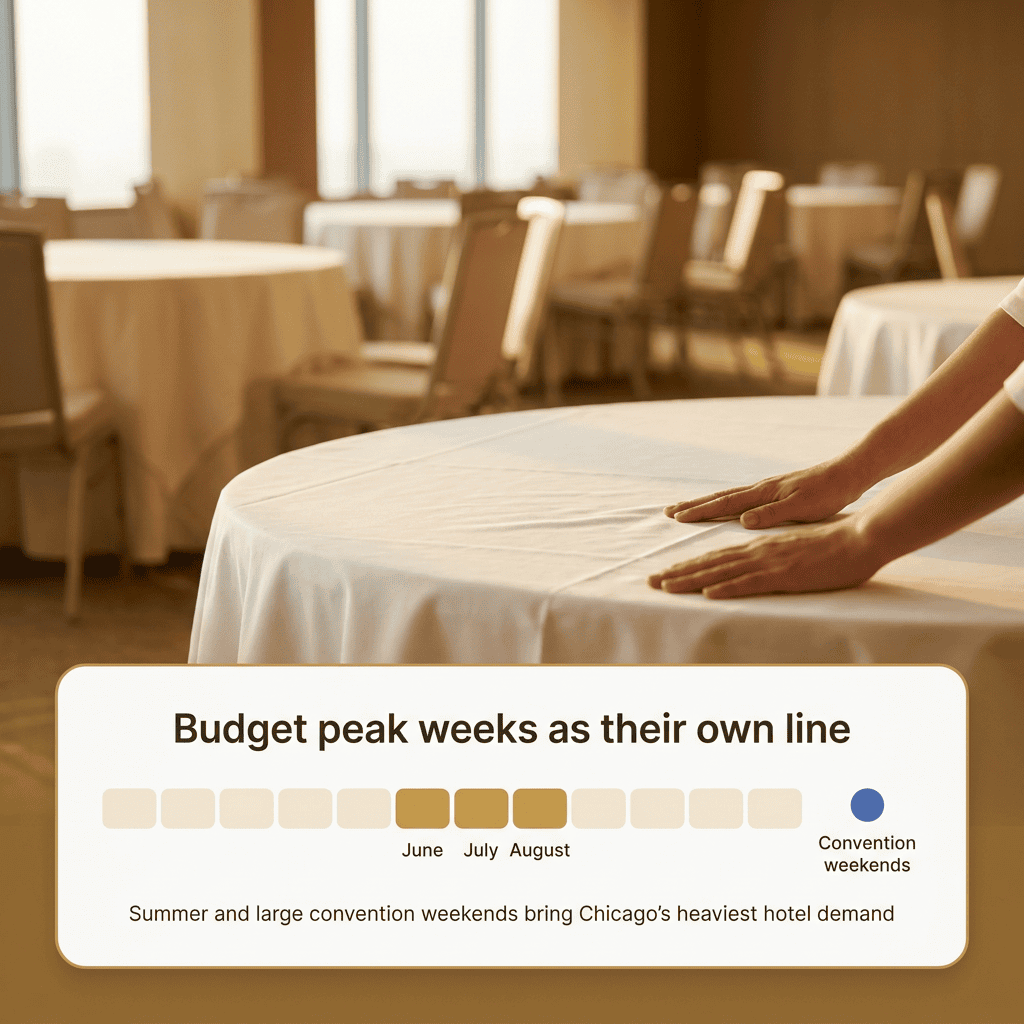
Chicago hotels see their heaviest demand in summer, from June through August, and on weekends when large conventions come to the city. A budget built only for your base staffing level does not cover the extra staff those weeks need. In our experience, when those weeks are not in the budget, hotels cover them with overtime, with last-minute shift changes that can add predictability pay, or with managers working shifts themselves. Budget the extra hours for summer and your known convention weekends as a separate line, so you can see what those weeks cost.
Is a staffing agency cheaper than hiring directly?
A staffing agency’s hourly rate is higher than the wage you would pay the same employee directly. In our experience, hotels that compare only those two numbers sometimes conclude an agency costs more. That comparison leaves out everything a direct hire costs beyond the wage. A W-2 hotel staffing partner‘s bill covers the wage and all of those added costs, so compare the partner’s bill with the full cost of the position. The result differs from one position to the next, so run the comparison one position at a time.
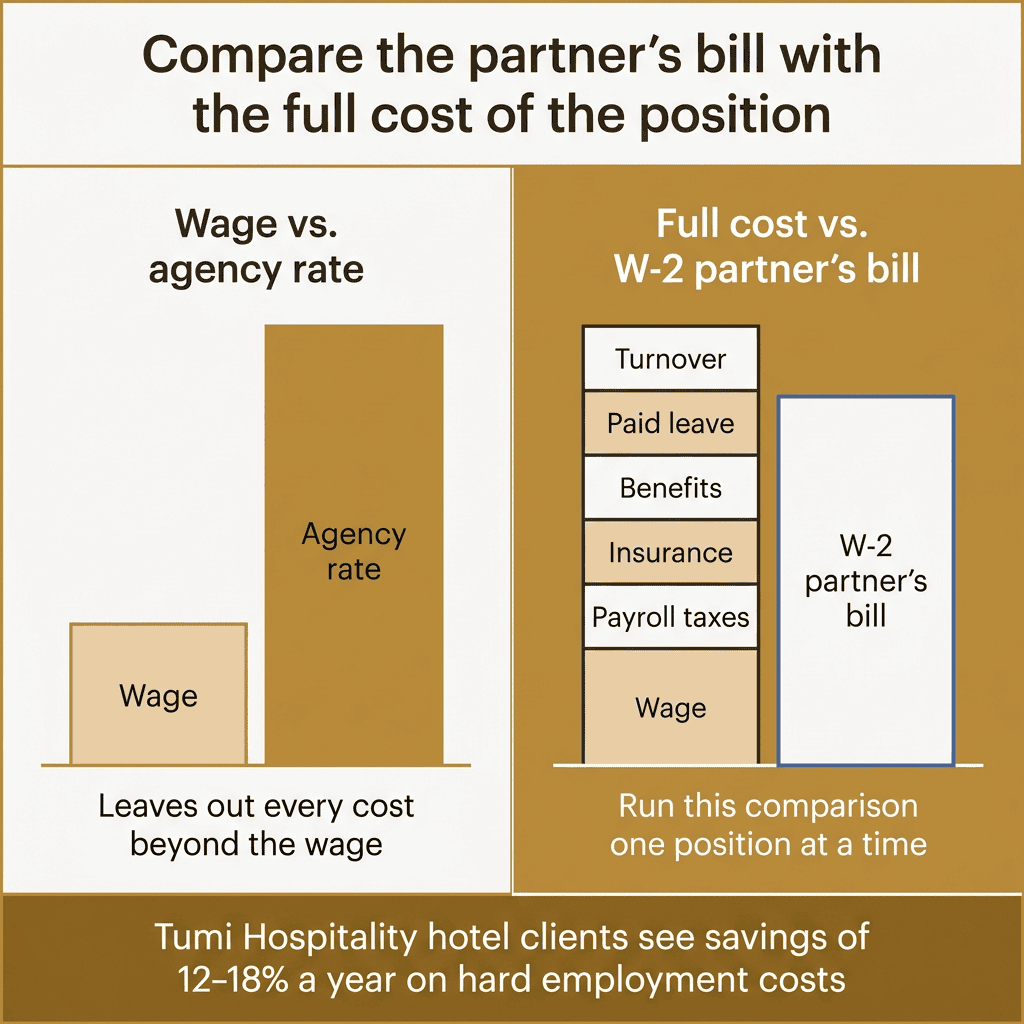
At Tumi Hospitality, our invoice includes the payroll taxes, insurance, benefits and administrative costs for our staff at your hotel, so you do not pay any of them separately. Our staff are W-2 employees with full benefits. If you are comparing firms, ask how each one employs its staff, because that affects which costs the firm’s rate covers. One difference between W-2 and 1099 workers is who pays Social Security and Medicare taxes: a firm pays the employer share for its W-2 employees, while 1099 workers pay the full amount themselves.
For our Chicago hotel staffing clients, an area manager visits each property every week. The weekly visits give you someone from our team at your hotel to answer questions and address staffing issues in person.
How to calculate the full cost of each position
Work through each position on its own, because wages, benefits and turnover differ from one role to the next.
- Start with the hourly rate you pay the position today, and make sure it meets the city minimum, or the tipped minimum for servers who earn tips. Include the next July 1 increase, of up to 2.5%, for anyone you pay at the minimum.
- Multiply the rate by the hours the position will work in a year, including the extra hours for summer and convention weekends. Keep the peak-week hours on their own line so you can see what they cost.
- Add payroll taxes, starting with 7.65% for Social Security and Medicare. Then add federal and Illinois unemployment tax for each person you expect to hold the position during the year.
- Add workers’ compensation at your insurer’s rate for the job class. Then add the monthly health premium for each employee you expect to enroll.
- Add up to 80 hours of paid leave per employee, plus the cost of covering those shifts. If Fair Workweek covers your hotel, set aside an amount for predictability pay based on how often your schedules change.
- Add turnover by estimating how many times the position will need to be refilled during the year. Budget a replacement cost of 20% to 30% of the position’s annual pay for each departure you expect.
Divide the total by the hours the position will work, and you have its full hourly cost. That full hourly cost is the number to compare with a staffing partner’s hourly rate for the same position.
Frequently asked questions
When does Chicago’s minimum wage go up next?
Chicago’s next minimum wage increase takes effect July 1, 2027. Chicago raises its minimum wage by the rate of inflation every July 1, up to 2.5% a year.
Does Chicago’s paid leave cover part-time hotel staff?
Yes. Once a part-time employee has worked 80 hours for you within 120 days in Chicago, they earn paid leave and paid sick leave on the same terms as full-time staff.
Do staffing agency workers cost more per hour than direct hires?
Yes, an agency’s hourly rate is higher than a direct hire’s wage, because the rate also covers the costs of employing someone, such as payroll taxes, insurance and benefits. To see which option costs less, compare the agency’s rate with the full hourly cost of the position rather than the wage. Our article on direct hire vs. a hotel staffing agency goes into more detail.
Help with your 2026 labor budget
If you would like help working out the full cost of your own positions, we are glad to go through them with you. You can contact us, call (512) 722-6000 or email info@tumihospitality.com to request a no-obligation consultation. We will talk through the staffing needs at your hotel and prepare a customized proposal you can compare with the full cost of each position.